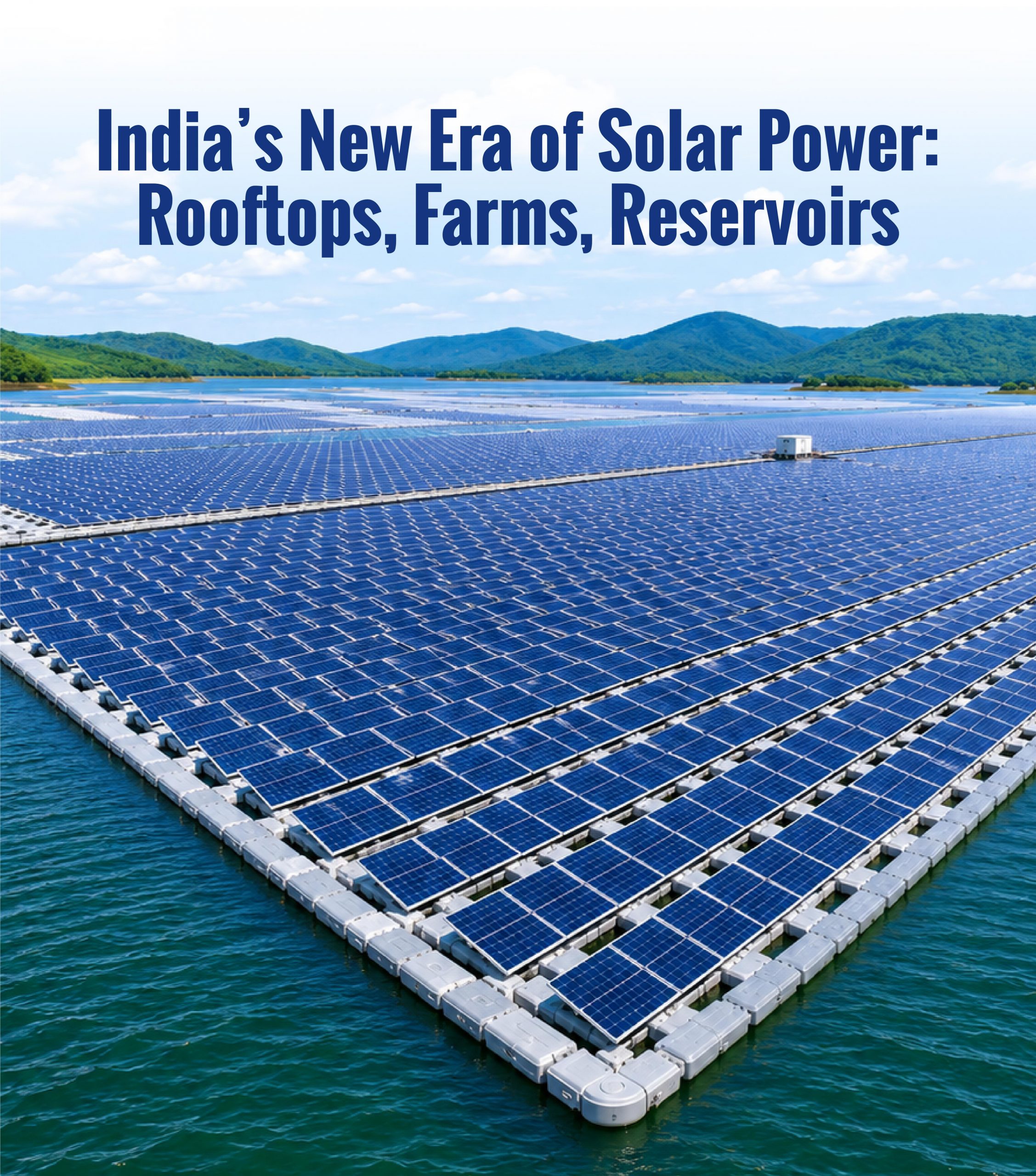
India’s New Era of Solar Power: Rooftops, Farms, Reservoirs
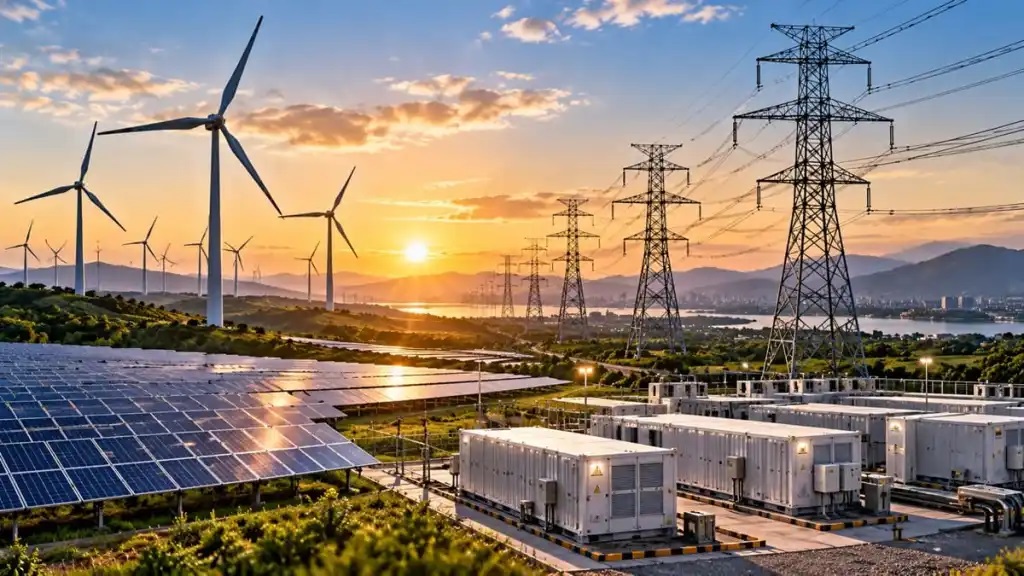
Over the past decade, India’s solar energy sector has gone through rapid growth and transition in terms of installed capacity, domestic manufacturing, solar adoption. Growing from a mere 2.82 GW in 2014 to about 175 GW in October 2026, India’s solar generation capacity has increased roughly 62 folds in the past 12 years. In 2025 alone, India had added almost 37 GW solar capacity, surpassing the United States and emerging as world’s second largest solar growth market, underlining its growing role in the global clean energy transition.
A Decade of Solar Growth
Such strong solar expansion is a result policy support, infrastructure development, manufacturing expansion, and citizen participation in the past decade. Key initiatives like ‘The National Solar Mission (2010)’, the Solar Parks Scheme, and the Green Energy Corridor Programme played a crucial role in accelerating large-scale solar deployments across the nation through diverse geographies and climate zones.
Regions like Gujarat, Karnataka, Rajasthan, Tamil Nadu, Maha, and Andhra Pradesh account for a significant share on these large scale solar deployment zones. India’s total large scale solar projects are already contributing 133 GW solar generation capacity which includes solar parks, mega solar projects, and rooftop solar projects.
A Glimpse of Record Additions and Recent Falling Costs
In the recent years, India has recorded significant additions to non fossil fuel capacity accounting to over 308 GWs as a part of its clean energy transition. Out of this 308 GW, about 56%, or 174.5 GW capacity accounts for the solar generation capacity reflecting the focus India has shown towards its renewable energy goals.
- In the current FY 2026-27, India added 24.29 GW of solar capacity, following the same pace as of previous financial year.
- India’s Solar module manufacturing capacity also increased from 2.3 GW in 2014 to about 192 GW in June 2026.
- In July 2025, renewable energy sources met 51.5% of India’s electricity demand, the highest monthly share recorded so far.
India’s Vision of A Cleaner Future: Policies & Commitments
Conducted in October 2021 – November 2026, India accounced its 5 Panchamrit Goals which included the goal to reach 500 GW of non fossil fuel capacity by the year 2030 along with another ambitious goal to become a net-zero carbon emmissions country by the year 2070.
One of India’s Prominent National Missions, Renewable Purchase Obligations (RPOs) require electricity distribution companies and other obligated entities to procure a specified share of their electricity from renewable sources. These RPOs provide long-term market certainty for developers and investors while encouraging greater renewable energy adoption.
PM Surya Ghar: Muft Bijli Yojana is another such scheme that is encouraging households to adopt rooftop solar systems. On the other hand, Pradhan Mantri Kisan Urja Suraksha evam Utthaan Mahabhiyan (PM-KUSUM) is playing a crucial role in promoting the adoption of solar pumps and feeder solarisation in the agriculture sector.
These initiatives are expanding the market for solar energy and strengthening participation across consumers, farmers, businesses, and power utilities.
Focus on Large Scale Solar Parks & Green Energy Corridor Programme
To provide developers with ready access to land and supporting solar infrastructure, Indian government introduced the Solar Parks Scheme with an initial target of 20 GW solar park capacity which was later expanded to 40 GW in 2017. However, by October 2026, India hit the mark of 39.46 GW solar park capacity with 56 solar parks across the country.
In support of the the Solar Parks Scheme, India also launched the Green Energy Corridor (GEC) Programme with a goal to facilitate the transfer of power from Renewable Energy rich areas to demand centres across the country and support the seamless integration of renewable energy into the electricity grid. As of February 2026, the programme had enabled the evacuation of 24,567.8 MW of renewable energy through strengthened transmission networks.
Here’s the list of solar parks installed across the states of India:
| S.no | States/Union Territories | No. of Parks | Capacity Sanction (MW) |
| 1 | Andhra Pradesh | 5 | 4200 |
| 2 | Bihar | 1 | 150 |
| 3 | Chhattisgarh | 1 | 100 |
| 4 | Gujarat | 7 | 12,150 |
| 5 | Jharkhand | 2 | 562 |
| 6 | Jharkhand and West Bengal* | 1 | 310 |
| 7 | Karnataka | 1 | 2000 |
| 8 | Kerala | 3 | 255 |
| 9 | Madhya Pradesh | 9 | 4208 |
| 10 | Maharashtra | 4 | 1,000 |
| 11 | Mizoram | 1 | 20 |
| 12 | Odisha | 1 | 40 |
| 13 | Rajasthan | 11 | 10,726 |
| 14 | Uttar Pradesh | 8 | 3,740 |
| Total | 54 | 39,461 |
India’s New Targets Towards a Greener Future
In the recent RE Expo 2026 conducted in Delhi from 2-5 November, India’s Prime Minister, Narendra Modi announced new targets for India’s non fossil fuel energy generation capacity. Addressing the media, he announced that India will target a renewable energy capacity of additional 500 GW in this decade bringing the goal from 500GW by 2030, to 800GW by the end of 2036.
Prahlad Joshi, Minister of New & Renewable Energy also mentioned how 21 lakh households out of 65 lakh households under the PM Surya Ghar Muft Bijli Yojana have already started to receive zero electricity bills. With massive subsidy under the scheme, many states have come up with additional solar schemes for the residents, making solar energy more accessible to common Indian households. Thus, fast-tracking the growth of India’s non-fossil energy generation capacity.
India’s Road Ahead
From 2.82 GW in 2014 to about 175 GW today, India’s solar journey shows what sustained policy support, domestic manufacturing and citizen participation can achieve. Flagship programmes like the Solar Parks Scheme, PM Surya Ghar and PM-KUSUM have taken solar from large parks to rooftops and farms. With the target now raised to 800 GW of non-fossil capacity by 2036, the coming decade will demand faster grid integration, battery storage and fresh investment. India’s brightest solar chapter may still lie ahead.