
• About Us
    • Awards & Felicitations
    • Our Company
    • Our Leadership
    • Our Projects
    • Testaments
  • Products
    • EV Charger
      • Spark Series (AC Charger)
      • Squad Series (DC Charger)
    • Solar Products
      • Solar Inverter
      • ServPort
      • Solar Management Unit
      • Solar Batteries
      • Solar Lithium Battery
      • Solar Panels
    • Power & Backup
      • Battery
      • Servo Stabilizer
      • UPS
    • Electric 3W Solutions
      • Lithium Battery
      • Electric 3W Charger
    • LEDs
      • Domestic LED
      • Commercial LED
    • Others
      • Oxygen Concentrator
      • UVC
  • Solutions
    • Solar EPC
    • Solar Calculator
    • EV Calculator
  • Media
    • Blogs
    • Events
    • Media Coverages
    • Media Kit
    • Press Releases
  • Investors
  • Contact

Type To Search

  • About Us
    • Awards & Felicitations
    • Our Company
    • Our Leadership
    • Our Projects
    • Testaments
  • Products
    • EV Charger
      • Spark Series (AC Charger)
      • Squad Series (DC Charger)
    • Solar Products
      • Solar Inverter
      • ServPort
      • Solar Management Unit
      • Solar Batteries
      • Solar Lithium Battery
      • Solar Panels
    • Power & Backup
      • Battery
      • Servo Stabilizer
      • UPS
    • Electric 3W Solutions
      • Lithium Battery
      • Electric 3W Charger
    • LEDs
      • Domestic LED
      • Commercial LED
    • Others
      • Oxygen Concentrator
      • UVC
  • Solutions
    • Solar EPC
    • Solar Calculator
    • EV Calculator
  • Media
    • Blogs
    • Events
    • Media Coverages
    • Media Kit
    • Press Releases
  • Investors
  • Contact

Type To Search

  • About Us
    • Awards & Felicitations
    • Our Company
    • Our Leadership
    • Our Projects
    • Testaments
  • Products
    • EV Charger
      • Spark Series (AC Charger)
      • Squad Series (DC Charger)
    • Solar Products
      • Solar Inverter
      • ServPort
      • Solar Management Unit
      • Solar Batteries
      • Solar Lithium Battery
      • Solar Panels
    • Power & Backup
      • Battery
      • Servo Stabilizer
      • UPS
    • Electric 3W Solutions
      • Lithium Battery
      • Electric 3W Charger
    • LEDs
      • Domestic LED
      • Commercial LED
    • Others
      • Oxygen Concentrator
      • UVC
  • Solutions
    • Solar EPC
    • Solar Calculator
    • EV Calculator
  • Media
    • Blogs
    • Events
    • Media Coverages
    • Media Kit
    • Press Releases
  • Investors
  • Contact
  • About Us
    • Awards & Felicitations
    • Our Company
    • Our Leadership
    • Our Projects
    • Testaments
  • Products
    • EV Charger
      • Spark Series (AC Charger)
      • Squad Series (DC Charger)
    • Solar Products
      • Solar Inverter
      • ServPort
      • Solar Management Unit
      • Solar Batteries
      • Solar Lithium Battery
      • Solar Panels
    • Power & Backup
      • Battery
      • Servo Stabilizer
      • UPS
    • Electric 3W Solutions
      • Lithium Battery
      • Electric 3W Charger
    • LEDs
      • Domestic LED
      • Commercial LED
    • Others
      • Oxygen Concentrator
      • UVC
  • Solutions
    • Solar EPC
    • Solar Calculator
    • EV Calculator
  • Media
    • Blogs
    • Events
    • Media Coverages
    • Media Kit
    • Press Releases
  • Investors
  • Contact

Category: Solar

Read More
Batterylithium-ion batterySolar
August 22, 2026by servotech team0 Comments
6 Likes

Servotech Launches New TVC For SERVLITH Solar Lithium Battery Featuring Sonu Sood

The way Indian homes consume and manage electricity is evolving. From smart appliances and home offices to rooftop solar systems and electric vehicles, today’s households require reliable, intelligent, and future-ready energy solutions.

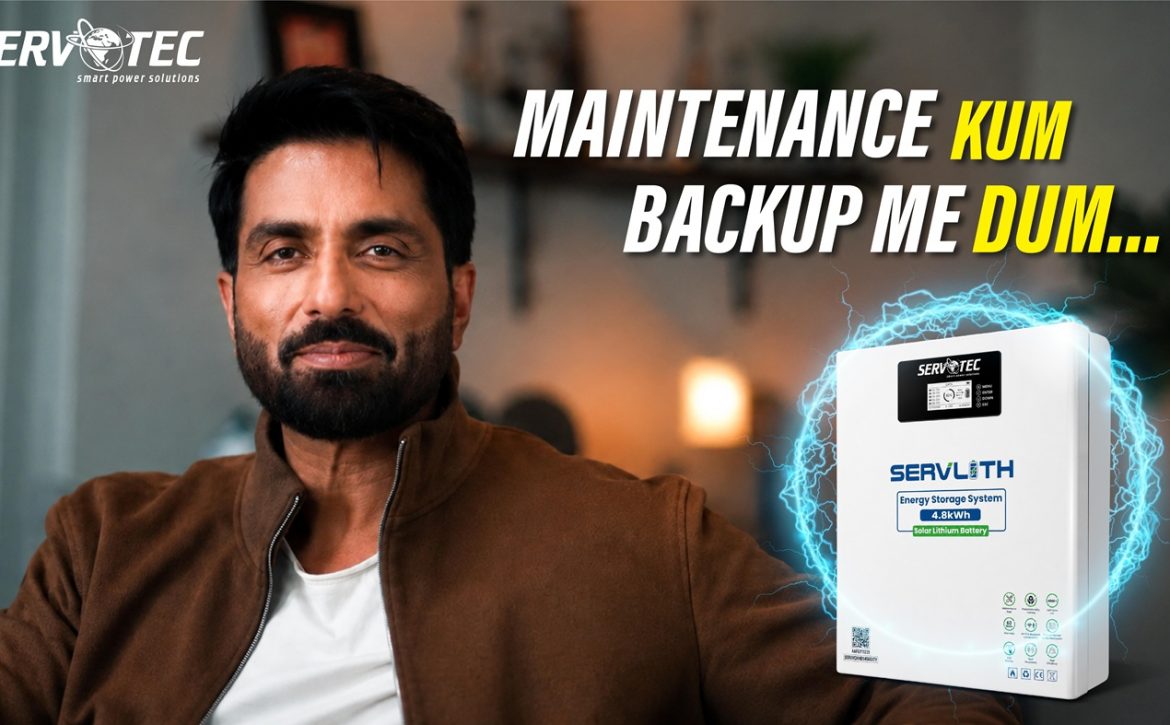
Recognizing this transformation, Servotech Renewable Power System Ltd. has launched its latest television commercial (TVC) featuring renowned actor and humanitarian Sonu Sood to introduce the SERVLITH Solar Lithium Battery .

The new campaign highlights a simple yet powerful message—modern homes deserve modern energy storage.

Instead of presenting energy storage as just another backup solution, the TVC showcases how lithium technology is redefining reliability, convenience, and long-term performance for Indian households. Through relatable storytelling and a strong product narrative, the campaign demonstrates why homeowners are increasingly moving beyond conventional battery systems and embracing intelligent energy storage solutions.

With this launch, Servotech continues its commitment to making advanced clean energy technologies more accessible while encouraging Indian families to upgrade to smarter and more efficient power backup solutions.

A New Chapter in Servotech’s Clean Energy Journey

Over the past few years, Servotech has consistently expanded its renewable energy portfolio to address the changing needs of consumers.

From EV charging infrastructure and rooftop solar solutions to advanced solar inverters and energy storage technologies, the company has been working towards creating an integrated clean energy ecosystem.

The launch of the new SERVLITH TVC represents another milestone in this journey.

By collaborating once again with Sonu Sood, Servotech aims to create greater awareness about lithium-based energy storage and encourage homeowners to adopt next-generation power backup solutions that offer better efficiency, longer life, and smarter energy management.

What the New TVC is All About

Unlike conventional advertisements that focus only on technical specifications, Servotech’s latest TVC takes a more relatable approach.

Set in a modern household, the commercial reflects everyday living and introduces the SERVLITH Solar Lithium Battery as a practical solution for today’s energy needs.

The campaign seamlessly combines lifestyle storytelling with product innovation.

As the narrative unfolds, viewers are introduced to the key advantages of lithium-based energy storage, supported by engaging visuals that highlight the product’s advanced technology and intelligent design.

Servotech’s latest TVC featuring Sonu Sood beautifully captures the evolution of home energy storage.

The campaign combines relatable storytelling with innovative technology to encourage homeowners to rethink the way they manage electricity.

Watch the official SERVLITH TVC on our YouTube channel and discover how smarter energy storage can transform modern living. 

Sonu Sood Continues His Association with Servotech

Sonu Sood has become a trusted face associated with initiatives that inspire confidence and positive change.

His continued collaboration with Servotech reflects the brand’s commitment to delivering innovative technologies that improve everyday life.

In the latest campaign, Sonu Sood effectively communicates the importance of choosing intelligent energy storage solutions over traditional alternatives.

His presence strengthens the campaign’s message while helping connect the product with a wider audience across the country.

SERVLITH Solar Lithium Battery

At the heart of the campaign is the SERVLITH Lithium Energy Storage System, developed to meet the energy demands of modern Indian homes.

Designed using advanced lithium battery technology, SERVLITH offers an efficient, intelligent, and reliable energy storage solution that supports uninterrupted living.

Whether it is powering essential household appliances, supporting home offices, or complementing rooftop solar installations, SERVLITH is built to deliver dependable performance with minimal maintenance.

Unlike conventional battery systems, it focuses on long-term efficiency while offering a cleaner and smarter approach to residential energy storage.

Key Highlights of the SERVLITH Solar Lithium Battery

The TVC showcases several features that make SERVLITH a next-generation energy storage solution.

1) Smart Battery Management System (BMS)

An intelligent Battery Management System continuously monitors battery performance to improve operational efficiency, enhance safety, and optimize battery life.

2) Longer Operational Life

One of the biggest highlights of the campaign is SERVLITH’s significantly longer lifespan compared to conventional battery technologies, making it a long-term investment for homeowners.

3) Low Maintenance

Traditional battery systems often require regular maintenance and periodic servicing.

SERVLITH is designed to minimize maintenance requirements, allowing homeowners to enjoy greater convenience.

4) Reliable Performance

Whether for everyday household usage or backup during unexpected power interruptions, SERVLITH is engineered to deliver dependable performance whenever required.

5) Modern Design

Its compact and contemporary design makes it suitable for today’s homes where space efficiency and aesthetics are equally important.

Why More Homeowners Are Choosing Lithium Energy Storage

The energy requirements of Indian households have changed dramatically.

Today’s homes rely on:

  • Smart TVs
  • High-speed internet
  • Home offices
  • Smart appliances
  • CCTV systems
  • Electric vehicle charging
  • Rooftop solar systems

Traditional backup solutions often struggle to keep pace with these growing demands.

Lithium Energy Storage Systems offer several advantages that align with modern lifestyles.

i) Higher Energy Efficiency

Lithium technology enables more efficient energy storage and utilization, helping homeowners make better use of available electricity.

ii) Faster Charging

Compared to conventional batteries, lithium systems generally support quicker charging cycles, allowing stored energy to become available sooner.

iii) Longer Lifespan

With significantly higher charge-discharge cycles, lithium batteries are designed for long-term reliability.

iv) Smarter Energy Management

Advanced battery management systems monitor performance continuously, improving overall efficiency and operational safety.

v) Lower Maintenance

Minimal maintenance requirements make lithium systems more convenient for residential users.

Supporting the Future of Smart Homes

As India moves towards cleaner and more connected energy ecosystems, energy storage is becoming an essential component of modern homes.

An intelligent Energy Storage System is no longer just about backup power.

It supports:

  • Smarter electricity management
  • Solar energy utilization
  • Future EV integration
  • Improved household reliability
  • Sustainable living

SERVLITH has been developed keeping these future requirements in mind, enabling homeowners to prepare for evolving energy needs.

Part of Servotech’s Integrated Clean Energy Ecosystem

The SERVLITH Solar Lithium Battery is one component of Servotech’s broader vision for sustainable energy.

The company offers a diverse portfolio that includes:

  • Rooftop Solar Solutions
  • Solar Inverters
  • EV Charging Infrastructure
  • Solar EPC Services
  • Energy Storage Technologies
  • Residential & Commercial Clean Energy Solutions

Together, these solutions help individuals and businesses transition toward a smarter and greener future.

Conclusion

The launch of Servotech’s new TVC featuring Sonu Sood marks another important milestone in the company’s mission to accelerate clean energy adoption across India.

By introducing the SERVLITH Solar Lithium Battery, the campaign emphasizes that modern homes require more than just traditional backup—they need intelligent, efficient, and future-ready energy solutions.

With advanced lithium technology, Smart BMS, low-maintenance operation, and long-lasting performance, SERVLITH represents the next generation of residential energy storage.

As homeowners continue to embrace renewable energy, smart homes, and connected lifestyles, innovative solutions like SERVLITH will play an increasingly important role in powering India’s sustainable future.

Read More
Solar
August 19, 2026by Prabhutva Tiwari0 Comments
40 Likes

Solar Panel Size Guide: Dimensions, Wattage & Roof Space Needed in India (2026 Guide)

Planning a rooftop solar system usually starts with one simple worry — will the panels actually fit on your roof? Most homeowners in India don’t have unlimited terrace space, and between water tanks, staircases, and overhead wires, the usable area can shrink fast. This is exactly where understanding solar panel size becomes useful, because it tells you not just how big one panel is, but how many you’ll need and how much roof area your dream system will actually require.

In this guide, we’ll walk you through everything: standard solar panel dimensions used in India today, how panel size differs between residential and commercial setups, a roof-space chart for 1kW to 10kW systems, how newer panel technologies like Mono PERC and TOPCon affect sizing, and what it all means for your final installation cost with subsidy. By the end, you’ll be able to look at your rooftop and know exactly what size of solar system it can realistically hold.

Book FREE Site Survey

Why Solar Panel Size Matters

Solar panel size directly decides how much electricity your roof can generate, how many panels you’ll need, and how efficiently your available space gets used.

Getting this right at the planning stage saves you from two common problems — an undersized system that doesn’t meet your electricity needs, or an oversized layout that simply won’t fit your roof.

Here’s why it matters in practice:

  • Energy output: Larger, higher-wattage panels generate more electricity per unit of roof area.
  • Panel count: Higher-wattage panels mean fewer panels are needed to reach the same system capacity.
  • Roof space planning: Correct sizing avoids wasted space and awkward panel layouts around obstructions like water tanks or AC units.
  • Installation cost: Fewer panels usually mean fewer mounting structures and less wiring, which can bring installation costs down slightly.
  • Future scalability: Knowing your panel-to-space ratio makes it easier to plan for adding capacity later if your electricity usage grows.

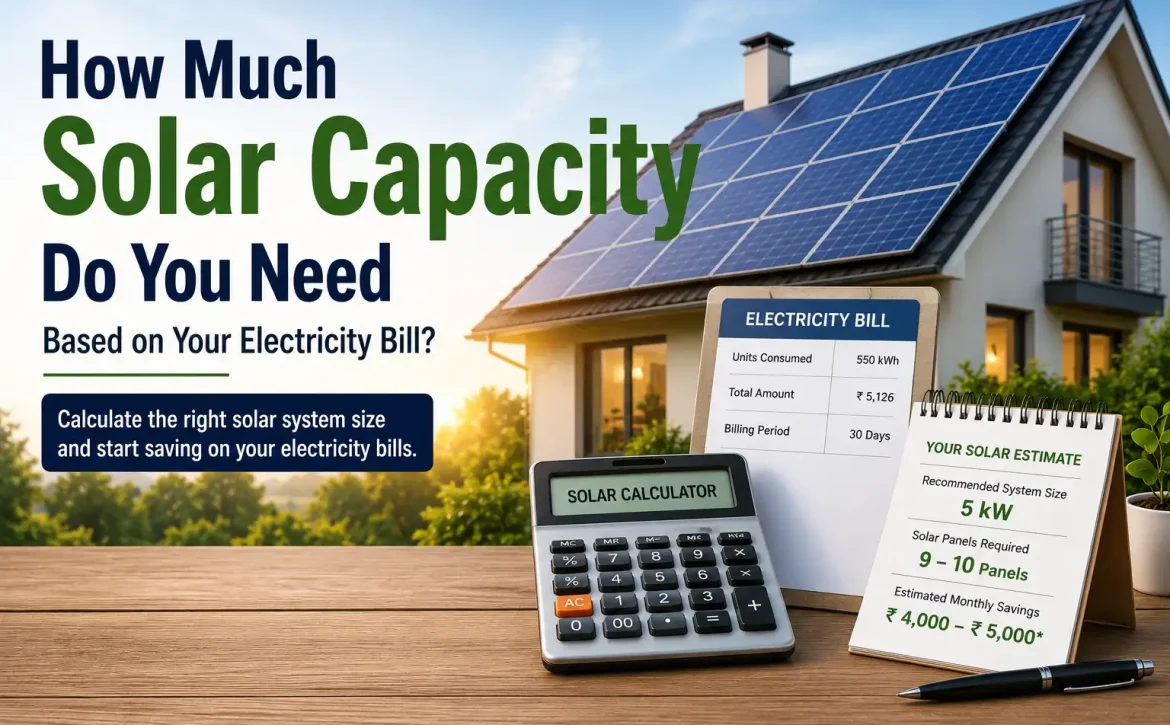
Read also: How Much Solar Capacity Do You Need Based on Your Electricity Bill?

What is the Standard Solar Panel Size in India?

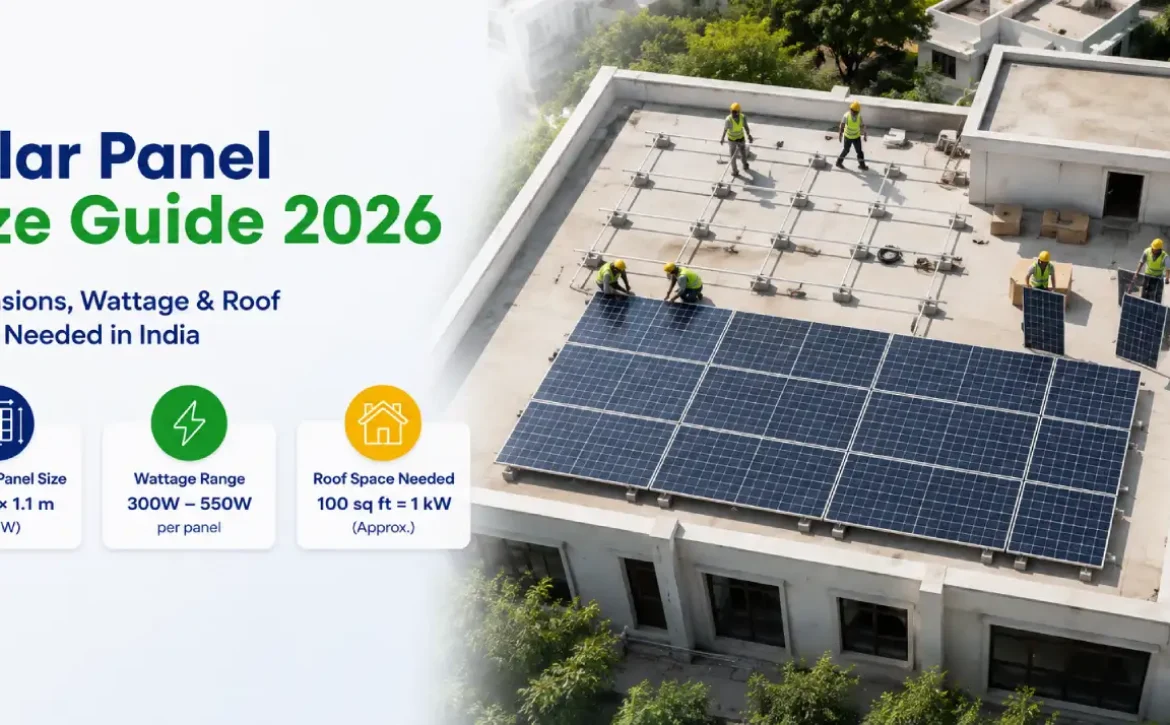
Most rooftop solar panels installed in India today measure approximately 2 to 2.1 meters in length and 1 to 1.1 meters in width, with wattage typically ranging between 500W and 600W+.

Panel sizing has changed considerably over the last few years as manufacturers moved toward higher-efficiency cell technology. Here’s a quick comparison of older versus current standard panels:

Older-generation panels (still available, lower wattage):

  • Cell configuration: 60-cell or early half-cut designs
  • Dimensions: ~1.6–1.7 m × ~1 m
  • Wattage: 300–400W
  • Weight: ~18–20 kg

Current-generation panels (widely used in 2026 installations):

  • Cell configuration: 144 half-cut cells
  • Dimensions: ~2–2.1 m × ~1–1.1 m
  • Wattage: 500–600W+
  • Weight: ~26–30 kg

Actual dimensions vary by manufacturer and cell technology, so it’s always worth checking the specific datasheet before finalising a panel brand.

Solar Panel Size Chart: Residential vs Commercial

Residential and commercial installations don’t just differ in scale — the panels used are often sized differently too, based on available roof area and energy demand.

FeatureResidential PanelsCommercial Panels
Common cell configuration120 half-cut, 144 half-cut72 full-cell, 144 half-cut, bifacial
Typical dimensions~1.7 m × 1 m (mid-wattage) to ~2.1 m × 1.1 m (high-wattage)~2.0–2.4 m × 1.1 m
Typical wattage330–600W500–600W+
Typical weight18–30 kg32–35 kg
Common system size range1kW – 10kW20kW – MW-scale

Why this matters: if you’re comparing quotes and one installer proposes noticeably fewer panels than another for the same system size, it likely means they’re using higher-wattage modules — not cutting corners. Always check the wattage-per-panel figure, not just the panel count.

Read also: 3kW Solar System in India: Price, Subsidy & Buying Guide

How Much Roof Space Do You Need? (1kW to 10kW Calculator)

As a general rule of thumb, a rooftop solar system needs approximately 100 square feet of shadow-free roof area per 1kW of capacity.

This is a planning estimate — actual space needed can vary slightly based on panel wattage, tilt angle, and layout, but it’s a reliable starting point for most Indian homes.

System SizeApprox. Panels Needed (540W panels)Shadow-Free Roof Area Needed
1 kW~2 panels~100 sq. ft
2 kW~4 panels~200 sq. ft
3 kW~6 panels~300 sq. ft
5 kW~9–10 panels~500 sq. ft
10 kW~18–19 panels~1,000 sq. ft

The formula is simple: Number of panels needed = System size (in watts) ÷ Panel wattage.

For example, a 3kW (3,000W) system built with 540W panels needs roughly 6 panels (3,000 ÷ 540 ≈ 5.5, rounded up).

Tip: Instead of manually calculating this, you can use Servotech’s Solar Calculator to instantly estimate the right system size and panel count based on your monthly electricity bill.

Read also: Can Your House Run on a 5kW Solar System?

How to Measure the Right Solar Panel Size for Your Home

You don’t need any special tools to get a reasonably accurate estimate before consulting an installer. Here’s how to approach it:

Step 1: Measure Your Usable Roof Area

Walk your terrace and identify the shadow-free zones. Exclude areas blocked by water tanks, staircases, parapet walls, or overhead lines — panels installed under shade produce significantly less power.

Step 2: Check Your Monthly Electricity Consumption

Pull out your last 2-3 electricity bills and note your average monthly and yearly usage in units (kWh). This tells you how much capacity you actually need, not just how much your roof can fit.

Step 3: Apply the Space-to-Capacity Rule

Divide your available shadow-free area by 100 sq. ft. to get a rough system size your roof can support.

Step 4: Match Roof Capacity With Consumption Needs

Compare what your roof allows against what your consumption requires. The right system size is the one that satisfies both — not just whichever number is bigger.

Step 5: Choose Panel Wattage Based on the Outcome

If your roof space is limited but your consumption is high, higher-wattage panels help you fit more capacity into less area. If space isn’t a constraint, mid-wattage panels can also work well.

Note: Tilt angle, roof orientation, and local shading patterns also affect real-world output, so a professional site survey is always recommended before finalising your system.

Panel Technology and Its Effect on Size — Mono PERC vs TOPCon

Solar panel size alone doesn’t tell the full story — the cell technology inside the panel affects how much power you get from that same physical footprint.

Mono PERC Solar Panels (Passivated Emitter and Rear Cell):

  • Uses monocrystalline silicon with a rear passivation layer that reflects unused light back into the cell
  • Efficiency of up to approximately 22.5%
  • Well-established, cost-effective, widely used across Indian rooftops

TOPCon Solar Panels (Tunnel Oxide Passivated Contact):

  • Uses N-type silicon with an advanced passivation layer for better electron flow
  • Efficiency of up to approximately 26%
  • Performs better in high-temperature conditions and typically degrades more slowly over time

What this means for your roof: for the same physical panel size, a TOPCon module will generally output more power than a Mono PERC module — useful information if your roof space is tight and you need to maximise output per square foot.

Factors Beyond Size That Affect Panel Performance

A bigger panel doesn’t automatically mean better long-term value. Before finalising your purchase, weigh these factors alongside size:

  • Efficiency: How much sunlight the panel actually converts into usable electricity
  • Temperature coefficient: How much output drops as panel temperature rises during Indian summers
  • Degradation rate: How much output the panel loses each year over its lifespan
  • Product warranty: Typically 12–25 years, covering manufacturing defects
  • Performance warranty: Usually 25 years, guaranteeing a minimum output percentage
  • Certification: Look for BIS and MNRE compliance to ensure safety and eligibility for subsidy schemes
Get Free Quote for Solar Panels, Inverters and Other Solar Accessories

Solar Panel Size vs Cost in India (with Subsidy)

Panel size and system capacity directly influence your total investment, but the PM Surya Ghar Muft Bijli Yojana subsidy significantly reduces the net cost for residential consumers.

Under the current scheme structure:

System SizeCentral Subsidy (Approx.)
1 kW₹30,000
2 kW₹60,000
3 kW and above₹78,000 (capped)

The final installed cost — before and after subsidy — depends on several variables beyond just panel size:

  • Panel brand and wattage selected
  • Inverter type and capacity
  • Mounting structure and roof type
  • Net metering charges from your DISCOM
  • Installer’s service quality and after-sales support

Because pricing varies by city, DISCOM, and installer, it’s best to get a personalised quote rather than relying on a generic number. You can use Servotech’s Solar Calculator to get an estimate tailored to your consumption and location.

Read also: How Much Electricity Can a Single Solar Panel Produce?

Why Choose Servotech for Your Rooftop Solar System

Getting the panel size and system capacity right is only half the job — the quality of installation determines how well your system performs over the next 25 years.

Servotech Renewable Power System Ltd. offers complete rooftop solar solutions designed around your actual roof space and electricity needs, including:

  • Free site assessment and shadow analysis
  • Custom system design matched to your roof dimensions
  • High-efficiency solar panels and advanced inverters
  • BIS/MNRE-compliant, ALMM-listed equipment
  • End-to-end subsidy documentation support
  • Net metering coordination with your DISCOM
  • Reliable after-sales service across India

Whether you’re working with a compact terrace or a large rooftop, Servotech helps you make the most of every available square foot.

Frequently Asked Questions (FAQs)

1. What is the standard solar panel size in India?

Most current rooftop panels measure approximately 2 to 2.1 meters in length and 1 to 1.1 meters in width, with wattage typically between 500W and 600W+.

2. How big is one solar panel?

It depends on wattage. A 330–400W panel is typically around 1.6–1.7 m × 1 m, while a 500–600W panel is closer to 2–2.1 m × 1–1.1 m.

3. How much does a solar panel weigh?

Modern high-wattage residential panels weigh approximately 26–30 kg, while larger commercial solar panels can weigh 32–35 kg.

4. How much roof space do I need for a 3kW solar system?

Roughly 9–10 panels if using 540W-class modules, though this can vary slightly with different panel wattages.

5. How many solar panels are needed for a 5kW system?

Roughly 9–10 panels if using 540W-class modules, though this can vary slightly with different panel wattages.

6. Does a bigger solar panel always mean more power?

Not necessarily size alone — cell technology and efficiency matter just as much. A smaller, high-efficiency TOPCon panel can outperform a larger, lower-efficiency panel.

7. What’s the difference between residential and commercial solar panel sizes?

generally optimised for limited rooftop space (1kW–10kW systems), while commercial panels are larger-format modules designed for bigger installations (20kW and above).

8. Can I install solar on a small rooftop?

Yes. Smaller roofs can still support a meaningful system size, especially with higher-wattage panels that reduce the number of modules needed.

9. Does shading affect the panel size I should choose?

Yes. If your roof has partial shading issues, your installer may recommend specific panel placement or technology choices to minimise the impact on output.

10. How long do solar panels typically last?

Quality panels generally come with a 25-year performance warranty and continue operating at a high percentage of their original output through that period.

11. Does panel size affect installation cost?

Indirectly. Fewer, higher-wattage panels can reduce mounting and wiring costs slightly, but overall pricing depends more on total system capacity and component quality.

12. Where can I check the ideal system size for my home?

You can use Servotech’s Solar Calculator to get a quick, consumption-based estimate of the right system size for your roof.

Conclusion

Solar panel size might seem like a small technical detail, but it’s actually one of the first things that determines whether your rooftop solar plan is realistic. Knowing the standard dimensions, understanding how roof space translates into system capacity, and factoring in newer technologies like TOPCon can help you make a far more informed decision than simply picking whichever quote looks cheapest.

The right approach is always to balance three things — your available roof space, your actual electricity consumption, and the panel technology that makes the most of both. Once these align, you’re not just installing solar panels — you’re setting up a system that will genuinely work for your home for the next 25 years.

Read More
Solar
August 12, 2026by servotech team0 Comments
81 Likes

Solar Subsidy in Haryana Explained: Eligibility, Benefits & How to Apply (2026 Guide)

Electricity consumption across Haryana has been climbing steadily, driven by growing use of air conditioners, water heaters, and home appliances, along with expanding residential and commercial development in cities like Gurugram, Faridabad, Panipat, and Karnal. As monthly power bills increase, more homeowners are looking for a sustainable way to cut costs without compromising on comfort.

One of the most practical answers to this problem is a rooftop solar system. To make solar adoption easier and more affordable, the central government runs the PM Surya Ghar Muft Bijli Yojana, and in Haryana this scheme is implemented through HAREDA (Haryana Renewable Energy Development Agency) in coordination with the state’s two power distribution companies.

If you’re a homeowner in Haryana planning to go solar, understanding the Solar Subsidy in Haryana can significantly bring down your upfront investment while shortening the time it takes to recover your costs.

This guide walks you through everything — eligibility, subsidy amount, the 5kW solar system price in Haryana with subsidy, the step-by-step application process, required documents, and answers to the questions homeowners ask most often.

Book FREE Site Survey

Why Rooftop Solar is Gaining Momentum in Haryana

Haryana receives strong solar irradiance for most of the year, which makes rooftop solar a genuinely efficient investment rather than just an environmental gesture.

Several factors are pushing adoption higher across the state:

  • Rising domestic electricity tariffs
  • Frequent voltage fluctuations in semi-urban and rural feeders
  • Central government financial assistance under PM Surya Ghar
  • Net metering support from UHBVN and DHBVN
  • Growing awareness of long-term savings
  • Increasing real estate demand for solar-ready homes

Read also: 3kW Solar System in India: Price, Subsidy, Specifications & Buying Guide

What is the Solar Subsidy in Haryana?

The Solar Subsidy in Haryana refers to the financial assistance available to eligible residential consumers under the PM Surya Ghar Muft Bijli Yojana for installing a grid-connected rooftop solar system.

Rather than bearing the full installation cost, eligible homeowners receive a fixed government subsidy based on the capacity of the system installed, credited directly to their bank account after the installation is inspected and commissioned by the local DISCOM.

The subsidy exists to:

  • Lower the entry barrier to residential solar
  • Reduce household electricity expenses
  • Support Haryana’s renewable energy targets
  • Encourage decentralised power generation across the state

For many families, this subsidy is the deciding factor that makes rooftop solar financially viable sooner rather than later.

Get Free Quote for Solar Panels, Inverters and Other Solar Accessories

PM Surya Ghar Muft Bijli Yojana is India’s flagship residential rooftop solar scheme, targeting one crore households nationwide. In Haryana, HAREDA acts as the state nodal agency, working alongside UHBVN and DHBVN to process applications, coordinate inspections, and facilitate net metering.

Key objectives of the scheme in Haryana include:

  • Making rooftop solar affordable for middle-income households
  • Reducing dependence on conventional grid electricity
  • Supporting the state’s clean energy transition
  • Helping consumers lower their monthly electricity bills over the long term

Homeowners should always verify the latest subsidy structure and any additional state-level assistance directly on hareda.gov.in, since scheme details and slab amounts are periodically revised.

Who is Eligible for Solar Subsidy in Haryana?

Not every rooftop installation automatically qualifies for the subsidy. To claim benefits under the PM Surya Ghar Muft Bijli Yojana Subsidy in Haryana, applicants generally need to meet the following conditions:

1. Residential Ownership

The applicant should own the residential property where the system is being installed. Joint ownership is typically accepted.

2. Valid Domestic Electricity Connection

You need an active residential connection from either UHBVN or DHBVN, depending on which part of Haryana you live in. Commercial or agricultural tariff connections do not qualify under the residential subsidy.

3. Adequate, Shadow-Free Rooftop Space

The roof should have enough unshaded area to accommodate the panels and receive consistent sunlight through the day.

4. Sanctioned Load Within Limits

The connection’s sanctioned load generally needs to fall within the scheme’s prescribed limit for residential rooftop systems.

5. Installation Through an Empanelled Vendor

The system must be installed using ALMM-listed (Approved List of Models and Manufacturers) equipment through a vendor registered on the national PM Surya Ghar portal.

6. Net Metering Compliance

The installed system needs to be grid-connected and eligible for net metering through your DISCOM.

Read also: Solar Subsidy in Uttar Pradesh 2026 Explained

How Much Solar Subsidy Can You Get in Haryana?

Under the central PM Surya Ghar Muft Bijli Yojana, the subsidy is structured based on system capacity:

  • 1kW system: Subsidy of approximately ₹30,000
  • 2kW system: Subsidy of approximately ₹60,000
  • 3kW and above: Subsidy capped at approximately ₹78,000

This subsidy amount applies uniformly under the central scheme, and Haryana has, at various points, also offered additional state-level assistance for specific consumer categories such as economically weaker sections. Since state-level top-ups are revised periodically, it’s worth checking hareda.gov.in for the current status before finalising your installer contract.

The subsidy is disbursed via Direct Benefit Transfer (DBT) straight into the applicant’s bank account, typically within 30 to 45 days of successful commissioning and net meter installation.

5kW Solar System Price in Haryana with Subsidy

One of the most searched questions among Haryana homeowners is:

“What is the 5kW solar system price in Haryana with subsidy?”

Since the central subsidy is capped at 3kW capacity (approximately ₹78,000), a 5kW system receives the same maximum subsidy amount, with the remaining 2kW of capacity priced at the standard market rate.

The final project cost for a 5kW system depends on several variables:

  • Solar panel technology (Mono PERC, Bifacial, etc.)
  • Inverter type and brand
  • Mounting structure and roof type
  • Wiring, cabling, and balance-of-system components
  • Installation complexity and site conditions
  • Net metering charges levied by the DISCOM
  • Brand warranty and after-sales service coverage

A 5kW system is typically well-suited for larger homes with higher electricity consumption — think multiple ACs, a water heater, and several major appliances running through the day.

Tip: Before committing to a system size, use Servotech’s Solar Calculator to estimate the ideal capacity based on your actual electricity consumption, so you don’t end up over- or under-sizing your investment.

Read also: How Much Solar Capacity Do You Need Based on Your Electricity Bill?

Benefits of Rooftop Solar Subsidy in Haryana

Even without the subsidy, rooftop solar makes financial sense over the long run. With government assistance, the case becomes considerably stronger.

1. Lower Upfront Investment

The subsidy directly reduces the amount you need to pay out of pocket, easing the initial financial burden.

2. Faster Payback Period

With a lower net cost, most Haryana households can recover their investment meaningfully faster than an unsubsidised system.

3. Reduced Monthly Electricity Bills

A correctly sized system can offset a large share of daily household consumption, cutting your DISCOM bill significantly.

4. Protection Against Tariff Hikes

Once installed, your solar system insulates a portion of your electricity needs from future tariff increases.

5. Higher Property Value

Solar-equipped homes are increasingly attractive to buyers who want lower running costs and a smaller carbon footprint.

6. Long Operational Life

Quality solar panels typically perform reliably for 25 years or more, delivering savings well beyond the payback period.

Book FREE Consultation

  • UHBVN (Uttar Haryana Bijli Vitran Nigam): Covers northern and central Haryana, including Ambala, Kurukshetra, Karnal, Panipat, Sonipat, Rohtak, and Jhajjar.
  • DHBVN (Dakshin Haryana Bijli Vitran Nigam): Covers southern Haryana, including Gurugram, Faridabad, Palwal, and Mewat.
  • Both DISCOMs process PM Surya Ghar applications and net metering requests through the national portal, but local turnaround times can vary slightly depending on inspection backlogs in your circle.

    How to Apply for Solar Subsidy in Haryana?

    Applying for the Solar Subsidy in Haryana has become considerably more streamlined with the national PM Surya Ghar portal. Here’s the step-by-step process.

    Step 1: Assess Your Energy Requirement

    Review your last few electricity bills to understand your average monthly consumption, connected load, and available rooftop space.

    Tip: Use Servotech’s Solar Calculator to get a quick capacity estimate before applying.

    Step 2: Register on the PM Surya Ghar Portal

    Visit the official PM Surya Ghar Muft Bijli Yojana portal and register using your mobile number, electricity consumer number, state, and DISCOM (UHBVN or DHBVN).

    Step 3: Submit Your Application

    Provide your consumer details, rooftop information, and the proposed system capacity you wish to install.

    Step 4: Get Technical Feasibility Approval

    Your DISCOM reviews the application and grants technical approval before installation can begin.

    Step 5: Install the Rooftop Solar System

    Once approved, an empanelled installer carries out the site survey, system design, panel and inverter installation, wiring, and safety testing.

    Step 6: Net Meter Installation and Inspection

    After installation, the DISCOM inspects the system and facilitates net meter installation, enabling you to export surplus solar power to the grid.

    Step 7: Subsidy Disbursement

    Once commissioning is confirmed on the national portal, the subsidy amount is credited to your registered bank account via DBT, generally within 30 to 45 days.

    Documents Required for Solar System Subsidy in Haryana

    Keep the following ready before you begin your application:

    • Aadhaar Card
    • PAN Card (if applicable)
    • Residential address proof
    • Recent electricity bill
    • Passport-size photograph
    • Rooftop ownership proof
    • Bank account details (for DBT)
    • Installation and commissioning documents (provided by your installer)

    Document requirements can be updated periodically, so it’s a good idea to confirm the current checklist on the official portal before applying.

    Understanding Net Metering in Haryana

    Net metering is what allows a rooftop solar system to actually pay for itself efficiently. It lets you export any surplus electricity your system generates during the day back to the grid, earning credits against the power you draw from the grid at night or on cloudy days.

    Why Net Metering Matters

    • Maximises the value of every unit your system produces
    • Reduces your net monthly electricity bill
    • Improves overall return on investment
    • Cuts down dependence on grid power during peak hours


    Read also: How Does Net Metering Make Solar Power More Accessible to Consumers

    Common Mistakes to Avoid While Applying

    Many Haryana homeowners lose time — or subsidy eligibility — over avoidable errors.

    1) Undersizing or Oversizing the System

    Choosing a capacity that doesn’t match your actual consumption pattern reduces both savings and efficiency.

    2) Prioritising Price Over Component Quality

    Cheaper panels and inverters can compromise long-term output and reliability.

    3) Skipping a Proper Roof Assessment

    Shadow analysis and structural evaluation are essential before finalising system design.

    4) Delaying the Net Metering Process

    Postponing net meter installation delays your ability to start saving — and in some cases, delays subsidy disbursement.

    5) Choosing an Unverified Installer

    Always confirm that your vendor is empanelled on the national PM Surya Ghar portal to avoid application rejection.

    Why Choose Servotech for Rooftop Solar in Haryana?

    Selecting the right installation partner is just as important as claiming the subsidy itself.

    Servotech Renewable Power System Ltd. offers complete rooftop solar solutions for residential consumers in Haryana, including:

    • Site assessment and shadow analysis
    • Custom system design based on your consumption
    • High-efficiency solar panels and advanced solar inverters
    • Professional, ALMM-compliant installation
    • Assistance with subsidy documentation
    • Net metering coordination with UHBVN/DHBVN
    • End-to-end project support and after-sales service

    With a strong presence across North India, Servotech helps Haryana homeowners navigate the subsidy process while ensuring a system that’s built to perform reliably for decades.

    Frequently Asked Questions (FAQs)

    1. What is the Solar Subsidy in Haryana?

    It’s the financial assistance available to eligible residential consumers under the PM Surya Ghar Muft Bijli Yojana for installing a rooftop solar system, disbursed as a direct bank transfer after commissioning.

    2. Who is eligible for solar panel subsidy in Haryana?

    Residential homeowners with an active domestic connection from UHBVN or DHBVN, adequate rooftop space, and installation through an empanelled vendor are generally eligible.

    3. How much subsidy can I get for a 3kW solar system in Haryana?

    A 3kW system is eligible for the maximum central subsidy of approximately ₹78,000 under the PM Surya Ghar scheme.

    4. What is the 5kW solar system price in Haryana with subsidy?

    The final cost depends on equipment, brand, and installation complexity, with the government subsidy capped at the 3kW slab amount even for larger systems.

    5. Which DISCOM covers my area — UHBVN or DHBVN?

    UHBVN covers northern and central Haryana; DHBVN covers southern Haryana, including Gurugram and Faridabad.

    6. Can commercial properties claim this subsidy?

    No, the residential subsidy under PM Surya Ghar is intended for domestic consumers. Commercial installations follow separate policies.

    7. What documents are needed to apply?

    Aadhaar Card, electricity bill, address proof, bank account details, rooftop ownership proof, and passport-size photograph are typically required.

    8. Is net metering compulsory for the subsidy?

    Yes, the installed system needs to be grid-connected and eligible for net metering to qualify for subsidy disbursement.

    9. Can apartment owners install rooftop solar in Haryana?

    Yes, subject to rooftop availability and any applicable housing society or RWA approvals.

    10. How long does the subsidy take to arrive after installation?

    Typically 30 to 45 days after successful DISCOM inspection and commissioning on the national portal.

    11. What role does HAREDA play in the subsidy process?

    HAREDA is the state nodal agency coordinating rooftop solar promotion and subsidy-related processes in Haryana, alongside UHBVN and DHBVN.

    12. Why do some subsidy applications get rejected?

    Common reasons include non-ALMM-listed equipment, incorrect sanctioned load details, incomplete documentation, or use of an unregistered installer.

    13. How long do solar panels typically last?

    High-quality panels generally offer a functional lifespan of 25 years or more with minimal maintenance.

    14. Does Haryana get enough sunlight for solar to be worthwhile?

    Yes. Haryana receives strong solar irradiance for most of the year, making rooftop solar highly effective for residential use.

    15. Where can I estimate the right system size for my home?

    You can use Servotech’s Solar Calculator to get a quick, consumption-based capacity estimate before applying.

    Read also: Solar Subsidy in Rajasthan Explained: Eligibility, Benefits & How to Apply

    Conclusion

    The Solar Subsidy in Haryana has made rooftop solar a genuinely accessible option for residential consumers across the state. Through the PM Surya Ghar Muft Bijli Yojana, homeowners in cities like Gurugram, Faridabad, Panipat, and Karnal can significantly lower their upfront investment while building toward long-term electricity savings and greater energy independence.

    That said, the real value of this subsidy depends on choosing the right system capacity, using quality components, and working with an experienced installation partner who can navigate the documentation and net metering process smoothly.

    With Haryana’s strong solar potential and a well-established central subsidy framework, there has rarely been a better time for homeowners in the state to make the switch to rooftop solar.

    Read More
    Solar
    August 2, 2026by servotech team0 Comments
    105 Likes

    Solar Subsidy in Delhi Explained: Eligibility, Benefits & How to Apply (2026 Guide)

    Electricity costs in Delhi continue to rise as residential electricity consumption increases due to air conditioners, smart appliances, electric vehicles, and work-from-home lifestyles. At the same time, more homeowners are looking for sustainable ways to reduce their monthly electricity bills while contributing to a cleaner environment.

    One of the most effective solutions is installing a rooftop solar system. To encourage residential solar adoption, the Government of India has introduced financial support through the PM Surya Ghar Muft Bijli Yojana, making solar installations more affordable for eligible households.

    If you’re planning to install a rooftop solar system, understanding the Solar Subsidy in Delhi can help you significantly reduce your upfront investment and enjoy long-term savings.

    In this comprehensive guide, we’ll explain everything you need to know about the Delhi Solar Subsidy, including eligibility, subsidy benefits, application process, required documents, and the estimated 5kW solar system price in Delhi with subsidy.

    Why is Rooftop Solar Becoming Popular in Delhi?

    Delhi is one of India’s fastest-growing urban regions with high residential electricity consumption and excellent solar potential.

    Several factors are encouraging homeowners to invest in rooftop solar:

    • Rising electricity tariffs
    • Increasing awareness of renewable energy
    • Government financial incentives
    • Net metering benefits
    • Better return on investment
    • Long-term electricity savings
    • Reduced carbon footprint

    Read also: List of Top 10 Solar Panel Manufacturers in India

    What is the Solar Subsidy in Delhi?

    The Solar Subsidy in Delhi is financial assistance provided under the PM Surya Ghar Muft Bijli Yojana, which encourages residential consumers to install rooftop solar systems.

    The subsidy helps reduce the overall installation cost, making solar energy more accessible and affordable for homeowners.

    Instead of bearing the complete cost of a rooftop solar installation, eligible consumers can receive government financial support based on the installed system capacity and prevailing scheme guidelines.

    The objective of this initiative is to:

    • Promote clean energy
    • Reduce household electricity bills
    • Increase rooftop solar adoption
    • Support India’s renewable energy goals

    For eligible homeowners, this can substantially lower the initial investment required for a residential solar system.

    Understanding PM Surya Ghar Muft Bijli Yojana

    The PM Surya Ghar Muft Bijli Yojana is one of India’s flagship rooftop solar initiatives aimed at accelerating residential solar adoption.

    The scheme focuses on encouraging households across the country to install rooftop solar systems while providing financial assistance through Central Financial Assistance (CFA).

    Some of the key objectives of the scheme include:

    • Making rooftop solar affordable for homeowners
    • Promoting renewable energy adoption
    • Reducing dependence on conventional electricity
    • Supporting sustainable urban development
    • Helping households reduce long-term electricity expenses

    For Delhi residents, the scheme provides an excellent opportunity to adopt solar energy while benefiting from government-backed incentives.

    Who is Eligible for Solar Subsidy in Delhi?

    Not every solar installation qualifies for subsidy.

    To receive benefits under the PM Surya Ghar Muft Bijli Yojana Subsidy in Delhi, applicants generally need to meet specific eligibility conditions.

    Typical eligibility requirements include:

    Residential Consumer

    The subsidy is primarily available for residential households.

    Commercial and industrial rooftop solar projects generally do not qualify under the residential subsidy scheme.

    Rooftop Ownership

    Applicants should have a suitable rooftop with adequate space for solar panel installation.

    The roof should receive sufficient sunlight throughout the day for optimal energy generation.

    Valid Electricity Connection

    The applicant should possess an active residential electricity connection in Delhi.

    Grid-Connected Rooftop Solar System

    The installed solar system should comply with applicable technical standards and be eligible for grid connectivity through net metering.

    Approved Vendors

    To ensure quality and compliance, homeowners are advised to install rooftop solar systems through registered or approved vendors as specified under the scheme guidelines.

    Benefits of Solar Subsidy in Delhi

    Installing a rooftop solar system offers benefits even without subsidy.

    However, government financial assistance makes the investment significantly more attractive.

    1. Lower Installation Cost

    The biggest advantage is the reduction in the initial investment required for installing rooftop solar.

    Government subsidy directly reduces the effective project cost.

    2. Reduced Electricity Bills

    A properly designed rooftop solar system can generate a significant portion of your daily electricity requirement, helping reduce monthly electricity expenses.

    3. Faster Return on Investment

    Since the subsidy lowers the upfront cost, homeowners generally recover their investment faster.

    4. Environment-Friendly Energy

    Solar power is a clean and renewable source of energy that reduces greenhouse gas emissions and dependence on fossil fuels.

    5. Increased Property Value

    Homes equipped with rooftop solar systems often become more attractive to environmentally conscious buyers.

    6. Long-Term Savings

    A rooftop solar system typically operates for decades with proper maintenance, delivering long-term financial benefits.

    How Much Solar Subsidy Can You Get in Delhi?

    The subsidy amount depends on the capacity of the rooftop solar system and the prevailing guidelines under the PM Surya Ghar Muft Bijli Yojana.

    While subsidy rates may be revised periodically by the government, eligible residential consumers can receive financial assistance for systems up to the prescribed capacity limits under the scheme.

    Before proceeding with installation, homeowners should verify the latest subsidy structure and applicable guidelines through the official PM Surya Ghar portal or consult an authorized solar installer.

    5kW Solar System Price in Delhi with Subsidy

    One of the most frequently searched questions is:

    “What is the 5kW solar system price in Delhi with subsidy?”

    The final project cost depends on several factors, including:

    • Solar panel technology
    • Inverter type
    • Mounting structure
    • Roof design
    • Installation complexity
    • Net metering requirements
    • Brand selection
    • Warranty and after-sales support

    A 5kW rooftop solar system is generally suitable for medium to large residential homes with moderate to high electricity consumption.

    After considering eligible government subsidy, the effective installation cost can be significantly lower than the original project price, making rooftop solar a financially attractive investment for homeowners.

    Tip: Instead of choosing a system based solely on price, compare efficiency, product quality, warranties, and installation expertise to maximize long-term savings.

    Why Choosing the Right Solar Installation Partner Matters

    Installing a rooftop solar system is a long-term investment.

    Selecting an experienced solar company ensures:

    • Proper system design
    • High-quality components
    • Professional installation
    • Assistance with subsidy documentation
    • Net metering support
    • Long-term maintenance services

    Servotech Renewable Power System offers end-to-end rooftop solar solutions, helping homeowners simplify the transition to clean energy while ensuring quality installation and reliable after-sales support.

    How to Apply for Solar Subsidy in Delhi?

    Applying for the Solar Subsidy in Delhi has become much simpler with the launch of the PM Surya Ghar Muft Bijli Yojana portal. Eligible homeowners can complete most of the application process online before proceeding with rooftop solar installation.

    Below is a step-by-step guide to help you understand the process.

    Step 1: Assess Your Energy Requirement

    Before applying, evaluate your monthly electricity consumption.

    Check your recent electricity bills to determine:

    • Average monthly units consumed
    • Connected load
    • Available rooftop space
    • Future electricity requirements

    Choosing the right system size ensures maximum energy savings and better return on investment.

    Tip: You can also use Servotech’s Solar Calculator to estimate the ideal rooftop solar system capacity based on your electricity consumption.

    Calculate your Solar Requirement Now

    Step 2: Register on the PM Surya Ghar Portal

    Visit the official PM Surya Ghar Muft Bijli Yojana portal and complete the registration process.

    You will generally need:

    • Mobile number
    • Electricity consumer number
    • State
    • Electricity distribution company (DISCOM)

    Step 3: Submit Your Application

    After registration, submit the rooftop solar application by providing the required details, including:

    • Consumer information
    • Rooftop details
    • Proposed system capacity
    • Installation location

    Step 4: Get Technical Approval

    Your local electricity distribution company (DISCOM) reviews the application and provides technical feasibility approval before installation begins.

    Step 5: Install the Rooftop Solar System

    After receiving approval, the rooftop solar system can be installed by an approved solar installer.

    A professional installation generally includes:

    • Site survey
    • System design
    • Solar panel installation
    • Inverter installation
    • Electrical connections
    • Safety testing

    Choosing an experienced installer ensures the system complies with applicable technical standards and performs efficiently over the long term.

    Step 6: Net Meter Installation & Inspection

    Once installation is completed, the DISCOM conducts inspection and facilitates net meter installation.

    Net metering allows homeowners to export excess solar electricity to the grid while importing electricity whenever required.

    Step 7: Subsidy Disbursement

    After successful inspection and commissioning, eligible subsidy benefits are processed according to the applicable scheme guidelines.

    Documents Required for Solar Subsidy in Delhi

    Applicants are generally required to keep the following documents ready:

    • Aadhaar Card
    • PAN Card (if applicable)
    • Residential Address Proof
    • Electricity Bill
    • Passport-size Photograph
    • Rooftop Ownership Proof
    • Bank Account Details
    • Installation Documents (as required)

    Requirements may vary depending on the latest government guidelines.

    Understanding Net Metering in Delhi

    Net metering plays a crucial role in maximizing the benefits of rooftop solar.

    It allows homeowners to export surplus electricity generated during the day and receive credits against future electricity consumption.

    Benefits of Net Metering

    • Better utilization of solar energy
    • Lower electricity bills
    • Improved return on investment
    • Reduced dependence on conventional electricity

    For homeowners installing rooftop solar under the Delhi Solar Subsidy, net metering significantly improves overall savings.

    Read also: The Procedure of Net Metering for On-Grid Solar Systems

    Common Mistakes to Avoid While Applying for Solar Subsidy

    Many homeowners delay or lose subsidy benefits due to avoidable mistakes.

    Here are some common ones:

    Choosing the Wrong System Capacity

    Installing an oversized or undersized system may reduce overall efficiency and financial returns.

    Selecting Low-Quality Components

    Choosing solar panels or inverters based only on price can affect long-term performance.

    Ignoring Roof Assessment

    Proper structural evaluation and shadow analysis are essential before installation.

    Delaying Net Metering

    Timely completion of the net metering process is important for maximizing savings.

    Not Verifying Vendor Credentials

    Always choose an experienced and trusted solar installation partner for quality workmanship and reliable after-sales support.

    Why Rooftop Solar Makes Sense for Delhi Homeowners

    Delhi enjoys abundant sunlight for most of the year, making rooftop solar one of the most practical renewable energy investments for homeowners.

    Installing rooftop solar can help:

    • Reduce electricity expenses
    • Improve energy independence
    • Lower carbon emissions
    • Increase property value
    • Support India’s renewable energy mission

    When combined with government subsidy, rooftop solar becomes even more financially attractive.

    Why Choose Servotech for Rooftop Solar Installation?

    Choosing the right solar partner is just as important as selecting the right solar system.

    Servotech Renewable Power System Ltd. provides complete rooftop solar solutions for residential customers, including:

    • Site Assessment
    • System Design
    • High-Efficiency Solar Panels
    • Advanced Solar Inverters
    • Professional Installation
    • Net Metering Assistance
    • End-to-End Project Support
    • After-Sales Service

    With years of experience in clean energy solutions, Servotech helps homeowners simplify the journey towards affordable and sustainable solar energy.

    Frequently Asked Questions (FAQs)

    1. What is the Solar Subsidy in Delhi?

    The Solar Subsidy in Delhi is financial assistance available to eligible residential consumers under the PM Surya Ghar Muft Bijli Yojana for installing rooftop solar systems.

    2. Who is eligible for rooftop solar subsidy in Delhi?

    Residential homeowners with a valid electricity connection and an eligible rooftop solar installation can apply, subject to government guidelines.

    3. Can commercial buildings get solar subsidy?

    The residential subsidy under PM Surya Ghar is generally intended for residential consumers. Commercial installations follow different policies.

    4. What is the 5kW solar system price in Delhi with subsidy?

    The final cost depends on the system configuration, equipment quality, installation requirements, and the applicable subsidy amount.

    5. Can apartments install rooftop solar?

    Yes, depending on rooftop availability and applicable housing society regulations.

    6. What documents are required?

    Typically Aadhaar Card, electricity bill, address proof, bank details, rooftop ownership proof, and other documents specified under the scheme.

    7. Is net metering compulsory?

    Net metering is generally recommended for grid-connected rooftop solar systems as it helps maximize savings.

    8. How long does installation take?

    Installation timelines vary depending on project size, approvals, and site conditions.

    9. How many solar panels are required for a 5kW system?

    The number depends on the wattage of the selected solar panels.

    10. Is rooftop solar safe?

    Yes, when installed professionally using certified components and following applicable safety standards.

    11. How long do solar panels last?

    High-quality solar panels typically offer operational lifespans of 25 years or more.

    12. Can rooftop solar eliminate electricity bills completely?

    Depending on your energy consumption and system size, rooftop solar can significantly reduce electricity bills.

    13. Does Delhi receive enough sunlight for solar power?

    Yes. Delhi has favorable solar irradiance, making rooftop solar highly effective for residential applications.

    14. Can I install solar today and apply for subsidy later?44

    Applicants should follow the latest government-approved process and guidelines to remain eligible for subsidy benefits.

    15. Where can I estimate the ideal rooftop solar capacity?

    You can estimate your system size using Servotech Solar Calculator before starting your rooftop solar journey.

    Read also: Solar Subsidy in Rajasthan Explained

    Conclusion

    The Solar Subsidy in Delhi has made rooftop solar more accessible than ever for residential consumers. Through the PM Surya Ghar:Muft Bijli Yojana, homeowners can reduce the initial cost of installation while enjoying long-term savings, cleaner energy, and greater energy independence.

    However, the success of a rooftop solar project depends not only on the subsidy but also on choosing the right system capacity, quality components, and an experienced installation partner.

    With Delhi’s favorable solar conditions and increasing focus on renewable energy, investing in rooftop solar today can deliver financial and environmental benefits for decades to come.

    Read More
    Solar
    July 24, 2026by servotech team0 Comments
    111 Likes

    How to Choose the Right Commercial Solar Power System for Your Business

    Electricity bills have been climbing every year, and most businesses feel it directly in their bottom line. Add to that the pressure of rising operational costs and growing expectations around sustainability, and it’s easy to see why so many companies are now looking seriously at solar power.

    But here’s the catch: installing solar isn’t the hard part anymore. Choosing the right commercial solar power system for your specific business is where most companies go wrong. Get the capacity, panel type, or inverter wrong, and you either overpay for a system you don’t need or end up with one that can’t keep up with your consumption.

    This guide walks you through everything you need to know — from understanding your electricity needs to calculating capacity, cost, and ROI — so you can make a decision that actually pays off.

    Why Businesses Are Investing in Commercial Solar Power Systems

    A few years ago, solar was seen as a “nice to have.” That’s changed. Here’s what’s driving the shift:

    • Rising electricity tariffs that show no signs of slowing down
    • Strong ROI — most commercial solar power systems pay for themselves within 3-5 years
    • ESG and sustainability commitments that investors and clients increasingly expect
    • Government incentives like accelerated depreciation and net metering
    • Energy independence — less reliance on grid supply and fewer disruptions
    • Brand value — customers and partners notice when a business invests in clean energy

    For most businesses, a solar power system for business use isn’t just about saving money anymore. It’s becoming part of how they operate and how they’re perceived.

    Commercial Solar vs Industrial Solar — What’s the Difference?

    People often use these terms interchangeably, but they’re not quite the same.

    FactorCommercial SolarIndustrial Solar
    Typical usersOffices, hotels, schools, hospitals, malls, retail storesFactories, manufacturing units, warehouses, processing plants
    Electricity consumptionModerateHigh
    Installation areaRooftop, limited spaceRooftop + ground-mounted, larger area
    System sizeUsually 10 kW – 500 kWOften 500 kW – several MW
    ROI period3-5 years2-4 years (due to higher usage)

    The core difference comes down to scale and consumption pattern. A hotel and a manufacturing plant might both want commercial solar panels, but the systems they actually need look nothing alike.

    Which System is Right for Your Business?

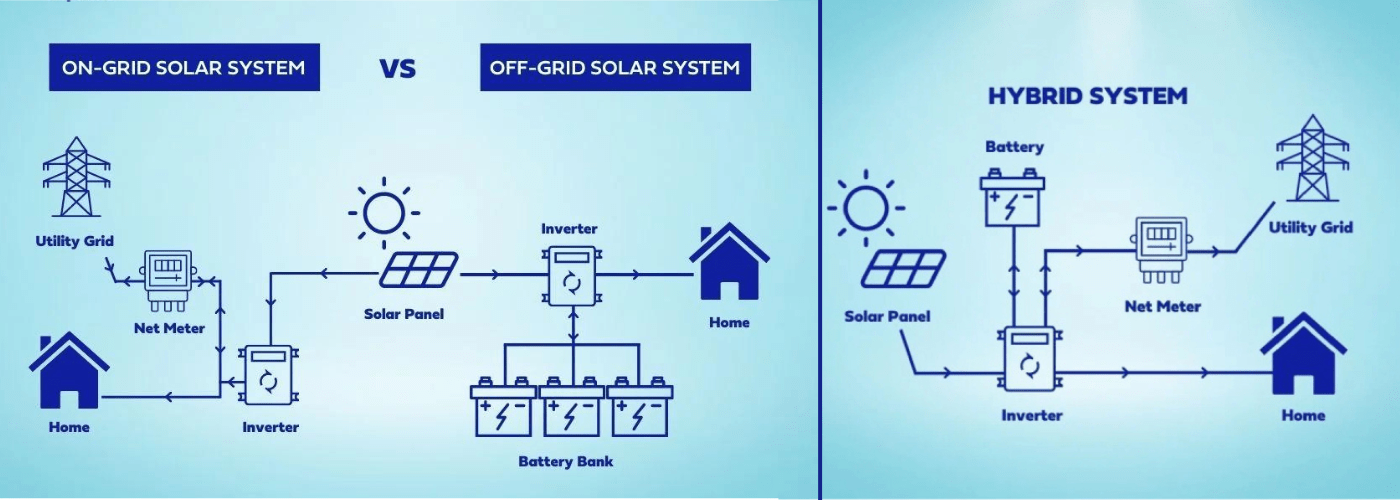
    Before picking a business type, it helps to know the basic system types on offer. Rooftop solar sits on your existing roof and works well when space is limited. Ground-mounted solar is used when you have open land available and need higher capacity than a rooftop can support. On-grid systems stay connected to the grid and export surplus power through net metering, but don’t run during a power cut. Hybrid systems add battery storage on top of an on-grid setup, so critical loads keep running even when the grid goes down. Most businesses end up choosing a mix of these based on space, budget, and how important backup power is to their operations.

    • Offices & IT companies: Rooftop on-grid systems usually work well, since daytime consumption aligns with solar generation.
    • Hotels & hospitals: These run 24/7, so a hybrid solar system with battery backup often makes more sense.
    • Schools & colleges: Daytime-only usage makes rooftop on-grid systems a cost-effective fit.
    • Warehouses & manufacturing plants: High load and available roof or ground space often call for larger rooftop or ground-mounted systems.
    • Shopping malls & retail chains: Given the high daytime footfall and AC load, a mix of rooftop and ground-mounted capacity is common.

    There’s no one-size-fits-all answer here — it genuinely depends on your load pattern, roof space, and future expansion plans.

    Calculating the Right Capacity for Your Business

    Before you talk to any installer, it helps to understand your own numbers.

    Step 1: Know your consumption.

    Pull out your last few electricity bills and check your monthly units consumed, maximum demand, and connected load.

    Step 2: Estimate the capacity.

    Required Capacity = Monthly Units ÷ Average Generation per kW

    In most parts of India, 1 kW of solar generates roughly 120-140 units a month. So if your business consumes around 6,000 units monthly, you’re likely looking at a 45-50 kW system.

    Business TypeMonthly Units (approx.)Suggested Solar Size
    Small office3,00020-25 kW
    Retail store6,00040-50 kW
    Hotel15,000100-120 kW
    Warehouse30,000200-250 kW
    Manufacturing unit75,000+500 kW – 1 MW

    These are rough benchmarks — an actual site survey and load analysis will always give you a more accurate number.

    Commercial Solar Panel Cost in India

    Cost depends on a few key factors: system capacity, panel type (Mono PERC, TOPCon, or bifacial), inverter choice, mounting structure, site location, and how complex the installation is.

    System SizeApproximate CostSuitable For
    50 kW₹18-22 lakhsSmall offices, retail stores
    100 kW₹35-40 lakhsHotels, mid-size warehouses
    250 kW₹85 lakhs – ₹1 croreLarge warehouses, factories
    500 kW – 1 MW₹1.8 – ₹3.5 croreManufacturing plants

    Prices vary by state, subsidy eligibility, and vendor, so treat these as ballpark figures rather than fixed quotes.

    Installation Process, Step by Step

    A typical commercial or industrial solar panel installation follows this sequence:

    Site survey

    — the installer inspects your roof or land, checks structural strength, and studies shadow patterns through the day.

    Load analysis

    — your consumption data is studied to confirm the right capacity.

    System design

    — panel layout, wiring, and inverter placement are finalized based on the survey.

    Government approval

    — paperwork for net metering and grid connectivity is filed with the local electricity board.

    Material procurement

    — panels, inverters, and mounting structures are sourced and delivered to site.

    Installation

    — the physical setup of panels, structure, wiring, and inverter takes place.

    Testing

    — the system is checked for safety and performance before going live.

    Net metering

    — the bi-directional meter is installed so surplus power can be exported to the grid.

    Commissioning

    — the system is switched on and starts generating power for your business.

    The entire process usually takes anywhere from a few weeks to a couple of months, depending on system size and approval timelines in your state.

    Choosing the Right Panels and Inverter

    Panels: Mono PERC panels are the most widely used and cost-effective option. TOPCon panels offer better efficiency and are a good fit for space-constrained rooftops. Bifacial panels, which capture sunlight from both sides, work well for ground-mounted industrial installations with reflective surfaces.

    Inverters: String inverters suit small to mid-size systems. Central inverters are typically used for large industrial installations. Hybrid inverters make sense if you want battery backup, and micro-inverters work best when your roof has partial shading issues.

    The right combination really depends on your roof condition, budget, and how much backup you need.

    What Affects Your ROI

    Your actual return depends on your local electricity tariff, system size, shadow-free roof area, net metering policy in your state, ongoing maintenance, and panel degradation over time. A shadow analysis in particular is often skipped, but even partial shading from a nearby structure or water tank can quietly cut your generation by a noticeable margin over the year. A well-designed system with quality panels can maintain 80%+ output even after 20-25 years, which is why panel quality matters more than most businesses realize upfront.

    How Much Can Your Business Actually Save?

    Business TypeMonthly Bill (approx.)Estimated Monthly Savings
    Office₹1.5 lakh60-70%
    Hotel₹4 lakh50-60%
    Hospital₹6 lakh45-55%
    Warehouse₹8 lakh55-65%
    Manufacturing unit₹15 lakh+50-60%

    Savings naturally vary based on system size, tariff structure, and how well the system is maintained.

    Net Metering and Government Incentives

    Net metering lets you feed excess solar power back into the grid and get credited for it, which significantly improves ROI. Businesses can also claim accelerated depreciation on solar assets, reducing tax outgo in the initial years. Some states offer additional subsidies or relaxed approval processes for commercial installations, so it’s worth checking your state’s specific solar policy before finalizing a system.

    Common Mistakes Businesses Make

    • Choosing a vendor based only on the lowest quote
    • Getting the capacity calculation wrong
    • Ignoring roof strength and structural load
    • Settling for low-quality panels to save upfront cost
    • Picking the wrong inverter type for the load pattern
    • Skipping a maintenance plan altogether
    • Not calculating ROI properly before investing

    Quick Checklist Before You Install

    ✔ Available roof or ground area

    ✔ Past 12 months of electricity bills

    ✔ Future expansion plans

    ✔ Budget and financing options

    ✔ Panel and inverter warranty terms

    ✔ Net metering eligibility in your state

    ✔ Track record of your installation partner

    ✔ A clear annual maintenance plan

    Why Businesses Prefer End-to-End Solar Solution Providers

    Solar isn’t just about panels on a roof — it’s site assessment, system design, installation, net metering paperwork, ongoing monitoring, and after-sales support, all working together. Businesses that go with fragmented vendors for each stage often end up dealing with delays, mismatched components, or poor post-installation support.

    This is where working with an established EPC partner makes a real difference. Servotech’s commercial and industrial solar solutions, for instance, cover the entire journey — from initial site survey to long-term maintenance — so businesses can focus on running their operations rather than managing multiple vendors.

    Frequently Asked Questions

    What is a commercial solar power system?

    It’s a solar installation designed specifically for businesses like offices, hotels, and retail stores, sized according to their electricity consumption.

    How is commercial solar different from industrial solar?

    Industrial solar is built for much higher loads — think factories and manufacturing units — while commercial solar suits moderate-consumption businesses.

    How long do commercial solar panels last?

    Most quality panels come with 25+ year performance warranties and continue generating power well beyond that.

    What is the cost of a commercial solar system in India?

    It ranges widely based on capacity — anywhere from ₹18 lakhs for a 50 kW system to a few crores for MW-scale installations.

    How much roof area is required?

    As a rough rule, 1 kW of solar needs about 80-100 sq. ft. of shadow-free space, so a 100 kW system would need roughly 8,000-10,000 sq. ft.

    How long does installation take?

    Typically a few weeks to a couple of months, depending on system size and local approval timelines.

    How many years does it take to recover the investment?

    Most commercial systems achieve payback within 3-5 years, sometimes faster for high-consumption businesses.

    Does solar work during power cuts?

    On-grid systems don’t work without grid power unless paired with a hybrid inverter and battery backup

    Which solar panels are best for commercial buildings?

    Mono PERC and TOPCon panels are currently the most popular choices for commercial rooftops due to their efficiency and reliability.

    Conclusion

    Choosing a commercial solar power system isn’t just an equipment purchase — it’s a long-term strategic decision. The businesses that get the most value are the ones that take time to understand their actual energy needs, compare technologies honestly, run the ROI numbers properly, and partner with an experienced EPC provider who can support them well beyond installation day. Do that, and solar stops being an expense — it becomes one of the smartest investments your business makes this decade.

    Read More
    Solarsolar pump
    July 5, 2026by servotech team0 Comments
    219 Likes

    Solar Subsidy in Rajasthan Explained: Eligibility, Benefits & How to Apply (2026)

    Rajasthan is often called India’s Solar Capital, and for good reason. With abundant sunshine throughout the year, vast open spaces, and strong government support for renewable energy, the state offers one of the best environments for rooftop solar adoption.

    As electricity consumption continues to rise across homes, many homeowners are exploring ways to reduce monthly power bills while investing in a cleaner and more sustainable future. This is where solar subsidy in Rajasthan plays a crucial role.

    The Government of India, through the PM Surya Ghar: Muft Bijli Yojana, is encouraging residential consumers to install rooftop solar systems by offering financial assistance that reduces the upfront installation cost.

    Whether you’re planning to install a 2kW, 3kW, or 5kW rooftop solar system, understanding the available subsidy, eligibility criteria, and application process can help you make an informed decision.

    In this comprehensive guide, we’ll explain everything you need to know about solar panel subsidy in Rajasthan, including subsidy amounts, eligibility, application steps, and how to maximize your savings with rooftop solar.

    Why Rajasthan is One of the Best States for Rooftop Solar

    Rajasthan receives some of the highest levels of solar radiation in India, making it an ideal location for generating electricity from solar energy.

    Several factors contribute to Rajasthan’s growing solar ecosystem:

    • More than 300 sunny days every year
    • High solar irradiation levels
    • Rapid expansion of renewable energy projects
    • Growing awareness of rooftop solar
    • Increasing electricity demand across residential areas
    • Government initiatives supporting clean energy adoption

    These advantages allow homeowners to generate more electricity from the same rooftop area compared to many other regions of the country.

    As a result, investing in rooftop solar often delivers excellent long-term savings and faster returns on investment.

    What is Solar Subsidy in Rajasthan?

    Solar subsidy in Rajasthan refers to the financial assistance available for eligible residential consumers installing rooftop solar systems under government-approved schemes.

    The primary objective of the subsidy is to:

    • Encourage residential rooftop solar adoption
    • Reduce electricity bills
    • Promote clean energy generation
    • Reduce dependence on conventional electricity
    • Help India achieve its renewable energy targets

    Today, most residential rooftop solar subsidies are offered under the PM Surya Ghar: Muft Bijli Yojana, making solar more affordable for homeowners.

    Besides reducing installation costs, rooftop solar also provides long-term savings by generating electricity directly from sunlight.

    PM Surya Ghar Muft Bijli Yojana Subsidy in Rajasthan

    The PM Surya Ghar: Muft Bijli Yojana is one of India’s largest residential rooftop solar initiatives, launched to encourage millions of households to adopt solar energy.

    The scheme provides financial assistance for eligible rooftop solar installations while simplifying the application process through an online portal.

    Objectives of the Scheme

    • Promote residential rooftop solar
    • Reduce household electricity expenses
    • Increase renewable energy generation
    • Support India’s Net Zero goals
    • Encourage decentralized electricity production

    Homeowners in Rajasthan can apply for the scheme through the official PM Surya Ghar portal after verifying eligibility and selecting an approved vendor.

    Benefits of PM Surya Ghar Muft Bijli Yojana in Rajasthan

    Installing rooftop solar under the scheme offers several advantages beyond the subsidy itself.

    1) Lower Electricity Bills

    One of the biggest advantages of rooftop solar is the significant reduction in monthly electricity expenses.

    Depending on system size and energy consumption, many homeowners can substantially reduce their dependence on grid electricity.

    2) Reduced Upfront Installation Cost

    Government financial assistance lowers the initial investment required for installing a rooftop solar system.

    This makes solar more accessible for middle-income households.

    3) Faster Return on Investment

    Since the installation cost is reduced through subsidies, homeowners can recover their investment sooner through electricity bill savings.

    4) Environment-Friendly Energy

    Solar energy is clean, renewable, and environmentally sustainable.

    By generating electricity from sunlight, homeowners reduce carbon emissions while supporting India’s clean energy mission.

    5) Increased Property Value

    Homes equipped with rooftop solar systems are increasingly viewed as energy-efficient properties, adding long-term value.

    Who is Eligible for Solar Subsidy in Rajasthan?

    Residential consumers planning to install rooftop solar systems should generally meet the following eligibility requirements.

    Basic Eligibility

    ✔ Applicant should be an Indian citizen.

    ✔ The property should have a suitable rooftop for solar installation.

    ✔ The electricity connection should be in the applicant’s name.

    ✔ The rooftop solar system should be installed through an approved vendor.

    ✔ The installation should comply with applicable guidelines under the PM Surya Ghar: Muft Bijli Yojana.

    Eligibility criteria may be updated from time to time, so applicants should verify the latest requirements before applying.

    Solar Subsidy in Rajasthan for Different System Capacities

    The subsidy available generally depends on the installed capacity of the rooftop solar system.

    System SizeSuitable ForCentral Subsidy*Estimated Savings Potential
    1kWSmall homesUp to ₹30,000Lower monthly electricity bills
    2kW1BHK / Small FamilyUp to ₹60,000Significant reduction in power bills
    3kW2BHK HomesUp to ₹78,000Ideal balance of investment and savings
    4kWLarge FamiliesUp to ₹78,000Higher solar generation
    5kW3BHK / Independent HousesUp to ₹78,000Maximum long-term savings
    Above 5kWVillas & High Consumption HomesAs per applicable guidelinesBest suited for higher energy needs

    Note: Subsidy amounts are based on the latest PM Surya Ghar: Muft Bijli Yojana guidelines and may change. Applicants should verify the latest information through the official portal before making a purchase decision.

    Choosing the Right System Capacity

    Many homeowners are unsure about which solar system size best suits their needs.

    A general recommendation is:

    Monthly Electricity BillRecommended Solar Capacity
    ₹1,500 – ₹2,5001kW–2kW
    ₹2,500 – ₹5,0003kW
    ₹5,000 – ₹8,0005kW
    ₹8,000+6kW–10kW

    Instead of relying on rough estimates, homeowners can use Servotech’s Solar Calculator to determine the ideal solar system size based on their electricity consumption. This naturally supports your internal link to the Solar Calculator page while helping readers make an informed decision.

    How Much Can You Save with Rooftop Solar in Rajasthan?

    With abundant sunshine throughout the year, Rajasthan offers excellent conditions for solar power generation.

    A properly designed rooftop solar system can help homeowners:

    • Generate clean electricity during daylight hours
    • Reduce dependence on conventional grid power
    • Lower monthly electricity expenses
    • Benefit from net metering (where applicable)
    • Improve long-term return on investment

    The exact savings depend on factors such as system size, electricity consumption, roof orientation, and local sunlight conditions.

    Solar Panel Subsidy in Rajasthan vs Solar Pump Subsidy in Rajasthan

    Many people confuse solar panel subsidy in Rajasthan with solar pump subsidy in Rajasthan. Although both initiatives promote renewable energy, they are designed for different users and applications.

    The PM Surya Ghar Muft Bijli Yojana focuses on residential rooftop solar systems, while solar pump subsidy schemes are intended to help farmers reduce irrigation costs by using solar-powered water pumps.

    Rooftop Solar SubsidySolar Pump Subsidy
    Designed for residential homesDesigned for farmers and agricultural use
    Supports rooftop solar installationsSupports solar-powered irrigation pumps
    Helps reduce household electricity billsReduces diesel and electricity costs for irrigation
    Available under PM Surya Ghar Muft Bijli YojanaAvailable under state and central agriculture schemes
    Suitable for urban and rural householdsSuitable for agricultural land and farms

    Understanding the difference helps applicants choose the right scheme based on their energy requirements.


    How to Apply for Solar Subsidy in Rajasthan

    Applying for the PM Surya Ghar Muft Bijli Yojana Subsidy in Rajasthan is straightforward if you follow the prescribed process.

    Step 1: Register on the Official Portal

    Visit the official PM Surya Ghar portal and register using your mobile number and electricity consumer details.

    Step 2: Select Your State and Electricity Distribution Company (DISCOM)

    Choose Rajasthan and your respective electricity distribution company while submitting the application.

    Step 3: Apply for Rooftop Solar Installation

    Fill in the required details, including:

    • Consumer number
    • Electricity connection details
    • Installation address
    • Proposed solar system capacity

    Step 4: Technical Approval

    Your application is reviewed by the concerned DISCOM, and technical feasibility is verified.

    Step 5: Installation by an Approved Vendor

    Once approved, install the rooftop solar system through an approved vendor following applicable quality standards.

    Step 6: Inspection and Net Meter Installation

    After installation, the system is inspected and a net meter is installed, where applicable, to facilitate energy export and billing adjustments.

    Step 7: Receive Subsidy

    Upon successful inspection and commissioning, the subsidy is processed and credited according to the applicable government guidelines.

    Documents Required for Solar Subsidy in Rajasthan

    Before applying, keep the following documents ready:

    • Aadhaar Card
    • PAN Card (if applicable)
    • Electricity bill
    • Address proof
    • Identity proof
    • Bank account details
    • Passport-size photograph
    • Rooftop ownership proof (if required)

    Having these documents ready can help streamline the application process.

    Understanding Net Metering in Rajasthan

    Net metering is an important aspect of rooftop solar systems.

    It allows homeowners to export excess electricity generated by their rooftop solar system to the electricity grid and receive credits, helping reduce their overall electricity expenses.

    Benefits of net metering include:

    • Better utilization of generated solar power
    • Lower electricity bills
    • Improved return on investment
    • Efficient energy management

    Before installation, homeowners should verify the latest net metering regulations applicable in Rajasthan through their local DISCOM.

    Why Rajasthan Leads India’s Solar Revolution

    Rajasthan is one of the most favorable states in India for solar energy generation due to its geographical and climatic conditions.

    Several factors contribute to its leadership in renewable energy:

    1. Excellent Solar Irradiation

    The state receives abundant sunlight throughout the year, enabling higher solar energy generation.

    2. Large Rooftop Potential

    Residential, commercial, and industrial buildings across Rajasthan have significant rooftop space suitable for solar installations.

    3. Government Support

    Schemes such as the PM Surya Ghar Muft Bijli Yojana are encouraging homeowners to invest in rooftop solar systems.

    4. Growing Renewable Energy Infrastructure

    Rajasthan continues to expand its renewable energy capacity, making solar power increasingly accessible to consumers.

    5. Rising Electricity Demand

    As electricity consumption grows, rooftop solar provides an effective solution for reducing long-term energy costs.

    Choosing the Right Rooftop Solar Partner

    Installing a rooftop solar system is a long-term investment, making it essential to choose a reliable technology provider and installation partner.

    When evaluating a solar company, consider:

    • Product quality
    • Installation expertise
    • Warranty coverage
    • Service network
    • Industry experience
    • After-sales support
    • Compliance with applicable standards

    Servotech Renewable Power System is an Indian renewable energy company offering solar solutions, EV chargers, and lithium-ion battery systems. The company provides rooftop solar solutions for residential, commercial, and industrial consumers, helping homeowners adopt clean energy through advanced solar technologies.

    Related Factors to Consider Before Installing Rooftop Solar

    Before investing in a rooftop solar system, homeowners should also evaluate:

    • Monthly electricity consumption
    • Roof orientation and available space
    • Future electricity requirements
    • Solar inverter selection
    • System capacity requirements
    • Applicable subsidy benefits
    • Net metering availability

    Understanding these factors helps ensure the selected system delivers optimal performance and long-term savings.

    Conclusion

    The solar subsidy in Rajasthan is making rooftop solar more accessible and affordable for homeowners. Through the PM Surya Ghar Muft Bijli Yojana, eligible residential consumers can reduce installation costs while enjoying long-term savings on electricity bills.

    With excellent solar potential, supportive government initiatives, and increasing awareness about renewable energy, Rajasthan is well-positioned to become one of India’s leading states for residential rooftop solar adoption.

    If you’re planning to install a rooftop solar system, now is an excellent time to explore available subsidy benefits and begin your journey toward cleaner, smarter, and more sustainable energy.

    Frequently Asked Questions (FAQs)

    What is the solar subsidy in Rajasthan?

    The solar subsidy in Rajasthan is primarily available under the PM Surya Ghar: Muft Bijli Yojana, which provides financial assistance to eligible residential consumers for rooftop solar installations.

    Who is eligible for PM Surya Ghar Muft Bijli Yojana Subsidy in Rajasthan?

    Residential homeowners with a valid electricity connection and suitable rooftop space can generally apply, subject to the latest government guidelines.

    How much subsidy is available for rooftop solar in Rajasthan?

    The subsidy amount depends on the installed solar capacity and the prevailing guidelines under the PM Surya Ghar: Muft Bijli Yojana.

    What is the difference between rooftop solar subsidy and solar pump subsidy in Rajasthan?

    Rooftop solar subsidy supports residential solar installations, while solar pump subsidy is intended for farmers installing solar-powered irrigation pumps.

    Can I apply for solar subsidy online?

    Yes. Eligible homeowners can apply online through the official PM Surya Ghar portal.

    Is net metering available in Rajasthan?

    Yes, net metering is available subject to the applicable regulations of the local electricity distribution company (DISCOM).

    Can I install a 5kW rooftop solar system with subsidy?

    Yes, eligible homeowners can install a 5kW rooftop solar system and avail subsidy as per the latest scheme guidelines.

    What documents are required for applying?

    Typically, applicants need identity proof, address proof, electricity bill, bank details, and other documents specified during the application process.

    How long does it take to receive the subsidy?

    The processing timeline depends on application verification, installation, inspection, and the applicable government procedures.

    Which solar system is best for a residential home in Rajasthan?

    The ideal system size depends on electricity consumption, roof space, and future energy needs. Many homeowners use a Solar Calculator to estimate the appropriate capacity before installation.

    Read More
    Solar
    June 26, 2026by Prabhutva Tiwari0 Comments
    798 Likes

    3kW Solar System in India: Price, Subsidy, Specifications, Benefits & Complete Buying Guide

    With rising electricity tariffs and growing awareness of renewable energy, more Indian homeowners are turning to rooftop solar systems to reduce their monthly electricity bills. Among the different system capacities available, the 3kW solar system has become one of the most popular choices for small to medium-sized households because it offers an excellent balance between affordability, power generation, and long-term savings.

    Whether you live in a 2BHK apartment, an independent house, or a small villa, a 3kW solar system can generate enough electricity to meet a significant portion of your daily energy requirements. When paired with net metering and government incentives such as the PM Surya Ghar Muft Bijli Yojana, homeowners can further reduce installation costs and improve their return on investment.

    However, before investing in solar, many homeowners have important questions:

    • What is the 3kW solar system price in India?
    • How many solar panels are required for a 3kW system?
    • Is a 3kW solar system enough for a 2BHK or 3BHK house?
    • How many units of electricity does it generate every day?
    • How much roof space is required?
    • Can it run an air conditioner?
    • What subsidy is available under the PM Surya Ghar Scheme?

    This comprehensive guide answers all these questions and explains everything you need to know about choosing the right 3kW solar system for your home.

    What is a 3kW Solar System?

    A 3kW solar system is a rooftop solar power system with a total installed capacity of 3,000 watts. It converts sunlight into electricity using photovoltaic (PV) solar panels and supplies clean electricity to homes, offices, and small commercial establishments.

    The system consists of multiple solar panels connected to a solar inverter, which converts the Direct Current (DC) generated by the panels into Alternating Current (AC) that powers everyday electrical appliances.

    A standard 3kW solar system generally includes:

    • High-efficiency solar panels
    • Solar inverter
    • Mounting structure
    • DC and AC cables
    • Protection devices
    • Net meter (for on-grid systems)
    • Battery bank (for off-grid or hybrid systems)

    With today’s high-wattage solar panels (540W–550W), a 3kW solar system typically requires 6 solar panels, making it a compact yet efficient solution for residential rooftops.

    How Does a 3kW Solar System Work?

    Understanding how a solar system works helps homeowners make informed decisions before installation.

    Step 1: Solar Panels Capture Sunlight

    Solar panels installed on the rooftop absorb sunlight throughout the day and convert solar energy into Direct Current (DC) electricity.

    Step 2: Solar Inverter Converts Electricity

    Since household appliances operate on Alternating Current (AC), the generated DC electricity passes through the solar inverter, where it is converted into usable AC electricity.

    The inverter also monitors system performance and ensures maximum energy conversion efficiency.

    Step 3: Electricity Powers Your Home

    The generated electricity is first consumed by household appliances such as:

    • LED lights
    • Ceiling fans
    • Television
    • Refrigerator
    • Washing machine
    • Air conditioner
    • Laptop and desktop computers

    This reduces dependence on electricity supplied by the utility grid.

    Step 4: Excess Electricity is Exported

    In an on-grid solar system, surplus electricity generated during the day is exported to the utility grid through net metering.

    The exported electricity is adjusted against future electricity consumption, helping reduce monthly electricity bills.

    Step 5: Grid or Battery Supplies Power When Needed

    At night or during cloudy weather, electricity is supplied either from:

    • The electricity grid (On-Grid System)
    • Battery storage (Hybrid or Off-Grid System)

    This ensures uninterrupted power availability throughout the day.

    3kW Solar System Specifications

    Before purchasing a solar system, homeowners should understand its technical specifications.

    SpecificationDetails
    System Capacity3kW
    Solar Panel Capacity3000 Watts
    Recommended Panel Wattage540W–550W
    Approximate Number of Panels6 Panels
    Daily Electricity Generation*12–15 Units
    Monthly Electricity Generation*360–450 Units
    Annual Electricity Generation*4,300–5,400 Units
    Roof Space Required180–220 sq. ft.
    Suitable For2BHK Homes, Small Villas, Shops & Offices
    System TypesOn-Grid, Off-Grid & Hybrid

    Note: Electricity generation depends on geographical location, solar irradiation, weather conditions, panel orientation, shading, and overall system efficiency.

    Components of a 3kW Solar System

    A well-designed 3kW solar system consists of several components that work together to generate and manage electricity efficiently.

    ComponentPurpose
    Solar PanelsCapture sunlight and generate DC electricity
    Solar InverterConverts DC electricity into AC electricity
    Mounting StructureSupports the solar panels on the rooftop
    Net MeterMeasures electricity imported from and exported to the grid
    DC & AC CablesConnect system components safely
    Safety DevicesProtect the system against electrical faults
    Battery (Optional)Stores electricity for backup in hybrid/off-grid systems

    Choosing high-quality components improves system performance, safety, and long-term reliability.

    Benefits of a 3kW Solar System

    A 3kW solar system offers several advantages for homeowners looking to reduce electricity expenses while adopting sustainable energy solutions.

    1. Significant Reduction in Electricity Bills

    One of the biggest benefits of installing a 3kW solar system is the reduction in monthly electricity costs. Depending on your energy consumption and location, a properly installed system can offset a substantial portion of your electricity usage.

    2. Clean and Renewable Energy

    Solar energy is one of the cleanest sources of electricity available today. A 3kW solar system generates electricity without producing harmful emissions, helping reduce your household’s carbon footprint.

    3. Government Subsidy Benefits

    Eligible residential consumers installing rooftop solar systems can benefit from financial assistance under government initiatives such as the PM Surya Ghar Muft Bijli Yojana, making solar installations more affordable.

    4. Low Maintenance Requirements

    Modern solar panels require minimal maintenance. Regular cleaning and periodic inspections are generally sufficient to keep the system operating efficiently for decades.

    5. Long Operational Life

    High-quality solar panels typically have a lifespan of 25 years or more, making a 3kW solar system a reliable long-term investment.

    6. Energy Independence

    Generating your own electricity reduces dependence on conventional power grids and protects homeowners from rising electricity tariffs.

    7. Environmentally Friendly

    By replacing fossil-fuel-based electricity with solar energy, homeowners contribute toward cleaner air and a more sustainable future.

    8. Increased Property Value

    Homes equipped with rooftop solar systems are increasingly viewed as energy-efficient properties, which can positively influence their market value.

    Types of 3kW Solar Systems

    Types of 3kW solar system

    A 3kW solar system is available in three different configurations based on your electricity requirements, budget, and backup power needs. Understanding the difference between these systems will help you choose the most suitable option for your home or business.

    1. 3kW On-Grid Solar System

    A 3kW on-grid solar system is directly connected to the electricity grid and does not require batteries for energy storage.

    During the daytime, the solar panels generate electricity to power your home. If the system generates more electricity than required, the surplus energy is exported to the grid through net metering. Likewise, when solar generation is low, electricity is imported from the grid.

    Best For

    • Urban homes
    • Residential societies
    • Homes with regular electricity supply
    • Users looking to reduce electricity bills

    Advantages

    • Lower installation cost
    • Higher efficiency
    • Net metering benefits
    • Low maintenance
    • Faster return on investment

    2. 3kW Off-Grid Solar System

    An off-grid solar system operates independently without relying on the electricity grid. It uses battery storage to provide electricity during the night or when sunlight is unavailable.

    These systems are commonly installed in remote locations where grid connectivity is limited or unreliable.

    Best For

    • Rural areas
    • Remote locations
    • Farmhouses
    • Areas with frequent power outages

    Advantages

    • Complete energy independence
    • Battery backup
    • Reliable power supply
    • No dependence on utility grid

    3. 3kW Hybrid Solar System

    A 3kW hybrid solar system combines the advantages of both on-grid and off-grid systems. It is connected to the electricity grid while also including battery storage for backup power.

    This allows homeowners to use solar energy during the day, store excess electricity in batteries, and export surplus energy to the grid when required.

    Best For

    • Homes experiencing frequent power cuts
    • Premium residential properties
    • Users seeking maximum energy independence

    Advantages

    • Battery backup
    • Grid connectivity
    • Better energy management
    • Increased energy security
    • Maximum utilization of solar energy

    3kW On-Grid vs Off-Grid vs Hybrid Solar System

    FeatureOn-GridOff-GridHybrid
    Grid Connection✔✘✔
    Battery Required✘✔✔
    Net Metering✔✘✔
    Backup During Power Cuts✘✔✔
    Installation CostLowestHigherHighest
    Best ForCitiesRemote AreasHomes with Frequent Outages

    Recommendation: For most urban homeowners, a 3kW on-grid solar system is the most cost-effective option due to lower installation costs and eligibility for net metering.

    3kW Solar System Price in India (2026)

    3kW Solar System Cost

    The 3kW solar system price in India depends on several factors, including the type of solar system, the quality of solar panels, inverter technology, installation charges, mounting structure, and location.

    Government subsidies under the PM Surya Ghar Muft Bijli Yojana can further reduce the overall installation cost for eligible residential consumers.

    Estimated 3kW Solar System Cost in India

    Solar System TypeEstimated Price Range*
    3kW On-Grid Solar System₹1,35,000 – ₹1,95,000
    3kW Off-Grid Solar System₹1,65,000 – ₹2,40,000
    3kW Hybrid Solar System₹1,80,000 – ₹2,70,000

    Note: Prices are indicative and may vary depending on the choice of solar panels, inverter brand, battery capacity, installation complexity, location, and applicable government subsidy.

    PM Surya Ghar Subsidy for a 3kW Solar System

    The Government of India is promoting rooftop solar adoption through the PM Surya Ghar Muft Bijli Yojana, making solar installations more affordable for residential consumers.

    A 3kW rooftop solar system is generally eligible for subsidy benefits as per the latest government guidelines, subject to eligibility criteria and applicable terms.

    Some of the benefits include:

    • Reduced upfront installation cost
    • Faster return on investment
    • Lower monthly electricity bills
    • Increased adoption of clean energy

    Before applying, homeowners should verify the latest subsidy guidelines and eligibility criteria on the official PM Surya Ghar portal.

    3kW Solar Panel Price for Home

    The cost of solar panels contributes significantly to the overall price of a rooftop solar system. The 3kW solar panel price for home varies depending on factors such as panel efficiency, technology, manufacturer, warranty, and installation requirements.

    Modern solar installations increasingly use Mono PERC or TOPCon solar panels because they offer higher efficiency and better performance than conventional polycrystalline panels.

    Factors Affecting Solar Panel Price

    • Solar panel technology
    • Panel efficiency
    • Brand reputation
    • Product warranty
    • Installation location
    • Mounting structure
    • Government subsidy

    Investing in high-quality solar panels can improve electricity generation, increase system reliability, and deliver better long-term returns.

    How Many Solar Panels Are Required for a 3kW Solar System?

    The number of solar panels required depends on the wattage of each panel.

    Solar Panel WattageApproximate Number of Panels
    330W9–10 Panels
    400W8 Panels
    450W7 Panels
    540W6 Panels
    550W6 Panels
    590W5–6 Panels

    Most modern residential installations use 540W–550W solar panels, requiring approximately 6 panels to achieve a total system capacity of 3kW.

    Roof Space Required for a 3kW Solar System

    Before installing a rooftop solar system, homeowners should ensure that sufficient shadow-free roof space is available.

    A typical 3kW solar system requires approximately 180–220 square feet of rooftop area, depending on the size and efficiency of the solar panels used.

    Factors Affecting Roof Space

    • Solar panel dimensions
    • Mounting structure design
    • Panel orientation
    • Tilt angle
    • Maintenance clearance

    Proper roof planning helps maximize energy generation and system efficiency.

    How Much Electricity Does a 3kW Solar System Generate?

    Electricity generation depends on several factors, including geographical location, sunlight availability, weather conditions, and panel orientation.

    Under favorable conditions, a 3kW solar system can generate approximately:

    Time PeriodEstimated Electricity Generation*
    Per Day12–15 Units
    Per Month360–450 Units
    Per Year4,300–5,400 Units

    This level of generation is sufficient to meet the daily electricity requirements of many small and medium-sized households.

    Why Is a 3kW Solar System So Popular in India?

    A 3kW solar system strikes the right balance between installation cost and energy output, making it one of the most preferred choices for residential users.

    Some key reasons for its popularity include:

    • Suitable for most urban households
    • Significant reduction in monthly electricity bills
    • Eligible for government subsidy (subject to prevailing guidelines)
    • Supports net metering
    • Requires relatively less roof space
    • Low maintenance
    • Long operational life of 25 years or more
    • Environmentally friendly and sustainable

    For families looking to reduce electricity expenses while contributing to a greener future, a 3kW solar system is often a practical and cost-effective solution.

    Home Appliances That Can Run on a 3kW Solar System

    One of the most common questions homeowners ask before installing rooftop solar is:

    “What appliances can a 3kW solar system run?”

    A 3kW solar system is suitable for households with moderate electricity consumption. While the exact appliance load depends on usage patterns and sunlight availability, it can comfortably power most essential household appliances during the daytime.

    Typical Appliances Supported by a 3kW Solar System

    ApplianceApproximate Power Consumption
    LED Lights (10–20W)100–200W
    Ceiling Fans (3–4)225–300W
    LED Television80–150W
    Refrigerator200–400W
    Washing Machine500–800W
    Laptop/Desktop50–150W
    Wi-Fi Router10–20W
    Water Pump (1 HP)750–1500W
    Air Cooler150–250W
    1 Ton Inverter AC*900–1200W

    Note: Actual performance depends on sunlight availability, appliance efficiency, inverter capacity, and whether multiple high-load appliances are operated simultaneously.

    Is a 3kW Solar System Right for Your Home?

    A 3kW solar system is ideal for households with moderate electricity consumption.

    It is generally recommended for:

    ✅ 2BHK Houses

    ✅ Small Independent Homes

    ✅ Villas with Moderate Electricity Usage

    ✅ Shops

    ✅ Small Offices

    Monthly Electricity Bill

    Generally suitable for households paying around:

    • ₹2,500–₹5,500 per month*

    If your electricity consumption is significantly higher, you may consider a 5kW solar system or a higher-capacity installation.

    Factors to Consider Before Installing a 3kW Solar System

    Before investing in rooftop solar, homeowners should evaluate several important factors.

    1. Monthly Electricity Consumption

    Your average monthly electricity usage helps determine whether a 3kW system is the right choice. Calculate your Solar Requirement

    2. Roof Space

    Ensure your rooftop has approximately 180–220 sq.ft. of shadow-free space.

    3. Panel Orientation

    South-facing rooftops with minimal shading generally produce better results.

    4. Solar Panel Quality

    High-efficiency Mono PERC or TOPCon solar panels usually generate more electricity compared to conventional technologies.

    5. Solar Inverter

    Choosing the right inverter is equally important since it directly impacts system efficiency.

    6. Government Subsidy

    Eligible residential consumers should check the latest PM Surya Ghar Muft Bijli Yojana subsidy before installation.

    Why Choose Servotech for Your 3kW Solar System?

    Choosing the right solar installation partner is just as important as selecting the right system size.

    Servotech Renewable Power System is an Indian renewable energy company offering rooftop solar solutions, solar inverters, EV chargers, lithium-ion battery systems, and complete solar EPC services for residential, commercial, and industrial applications.

    With years of experience in India’s renewable energy sector, Servotech offers:

    • High-quality solar panels
    • Reliable solar inverters
    • Professional installation
    • After-sales support
    • Rooftop solar solutions
    • Government subsidy guidance
    • End-to-end project execution

    Whether you’re installing your first rooftop solar system or upgrading an existing one, choosing a trusted renewable energy partner can significantly improve long-term system performance.

    Conclusion

    A 3kW solar system is one of the most practical and cost-effective rooftop solar solutions for Indian households with moderate electricity consumption. It offers an excellent balance between affordability, energy generation, and long-term savings.

    With benefits such as lower electricity bills, clean energy generation, government subsidy opportunities, and low maintenance requirements, a 3kW solar system has become a preferred choice for homeowners looking to transition toward sustainable energy.

    Before making a purchase decision, homeowners should carefully evaluate their monthly electricity consumption, available roof space, and future energy requirements.

    Using a reliable Solar Calculator and consulting experienced solar professionals can help you choose the right system capacity and maximize your return on investment.

    Frequently Asked Questions (FAQs)

    What is the price of a 3kW solar system in India?

    The price of a 3kW solar system depends on the system type, component quality, installation location, and applicable government subsidy. On-grid systems are generally the most affordable option.

    How many solar panels are required for a 3kW solar system?

    A 3kW solar system usually requires around 6 solar panels when using modern 540W–550W modules.

    How many units of electricity does a 3kW solar system generate?

    Under favorable conditions, a 3kW system can generate approximately 12–15 units of electricity per day, depending on location and weather conditions.

    Is a 3kW solar system enough for a 2BHK house?

    Yes. A 3kW solar system is generally suitable for most 2BHK homes with moderate electricity consumption.

    Does a 3kW solar system qualify for government subsidy?

    Eligible residential consumers may receive subsidy benefits under the PM Surya Ghar: Muft Bijli Yojana, subject to prevailing government guidelines.

    How much roof space is required?

    Approximately 180–220 square feet of shadow-free rooftop area is recommended.

    Which is better: On-Grid or Hybrid?

    For urban households with reliable grid connectivity, an on-grid solar system is generally more economical. Hybrid systems are better suited for areas with frequent power outages.

    What is the lifespan of a 3kW solar system?

    High-quality solar panels typically last 25 years or more, while inverters may require replacement depending on usage and manufacturer specifications.

    Can a 3kW solar system run an air conditioner?

    Yes. A 3kW solar system can support a 1-ton inverter AC along with other household appliances, provided the overall load remains within system capacity.

    How can I calculate the right solar system size for my home?

    You can estimate the appropriate system capacity based on your monthly electricity consumption by using Servotech’s Solar Calculator.

    Ready to Switch to Solar?

    Planning to install a rooftop solar system but unsure whether a 3kW solar system is the right choice?

    Use Servotech’s Solar Calculator to estimate the ideal solar system size based on your electricity consumption, calculate potential savings, and explore available government subsidy benefits.

    👉 Explore Servotech’s Rooftop Solar Solutions Today

    Read More
    Solar
    June 18, 2026by servotech team0 Comments
    235 Likes

    How Much Solar Capacity Do You Need Based on Your Electricity Bill?

    One of the first questions homeowners ask when considering rooftop solar is:

    “How much solar capacity do I actually need?”

    The answer depends largely on your monthly electricity consumption and electricity bill amount. Installing a system that is too small may not generate enough power, while an oversized system could increase your investment unnecessarily.

    Fortunately, determining the right solar system size is easier than ever. By analyzing your electricity bill and using a reliable solar calculator, homeowners can estimate the ideal solar capacity for their homes.

    In this guide, we’ll explain how to calculate solar requirements based on your electricity bill, understand different solar system capacities, and determine how many solar panels you may need for your home.

    Why Your Electricity Bill Is the Best Starting Point

    Your monthly electricity bill provides valuable insights into:

    • Energy consumption patterns
    • Average monthly units consumed
    • Peak usage periods
    • Potential solar savings

    Instead of guessing, homeowners should use actual consumption data to determine solar system size.

    A modern solar panel calculator helps simplify this process by converting electricity usage into recommended solar capacity.

    How to Calculate Solar Capacity Based on Electricity Consumption

    The first step is understanding your monthly electricity consumption in units (kWh).

    Most electricity bills display:

    • Monthly units consumed
    • Billing period
    • Total payable amount

    For example:

    Monthly Units ConsumedRecommended Solar Capacity
    150–250 Units1kW – 2kW
    250–450 Units2kW – 3kW
    450–700 Units3kW – 5kW
    700–1000 Units5kW – 8kW
    1000+ Units10kW+

    These estimates may vary depending on location, sunlight availability, and consumption patterns.

    Solar Capacity Based on Monthly Electricity Bill

    Many homeowners find it easier to estimate system size based on bill amount rather than energy units.

    For ₹2,000 Electricity Bill

    A monthly electricity bill of around ₹2,000 often indicates moderate consumption.

    Recommended System Size:
    1kW – 2kW Rooftop Solar System

    Suitable for:

    • Small families
    • Apartments
    • 1BHK homes

    For ₹5,000 Electricity Bill

    A ₹5,000 monthly electricity bill generally indicates higher electricity usage.

    Recommended System Size:
    3kW – 5kW Solar System

    Suitable for:

    • 2BHK homes
    • Small independent houses
    • Moderate appliance usage

    For ₹10,000 Electricity Bill

    Households paying around ₹10,000 per month typically consume significant electricity.

    Recommended System Size:
    5kW – 8kW Solar System

    Suitable for:

    • Large families
    • 3BHK homes
    • Homes with air conditioners and multiple appliances

    How Many Solar Panels Do I Need?

    One of the most searched questions online is:

    How Many Solar Panels Do I Need?

    The answer depends on:

    • System capacity
    • Solar panel wattage
    • Roof space availability

    Assuming modern 550W solar panels:

    System SizeApproximate Number of Panels
    1kW2 Panels
    2kW4 Panels
    3kW6 Panels
    5kW9–10 Panels
    10kW18–20 Panels

    This is where a solar panel requirement calculator becomes extremely useful, helping homeowners estimate panel requirements instantly.

    Factors That Influence Solar Capacity Requirements

    Electricity bill is important, but it isn’t the only factor.

    Roof Space Availability

    Larger systems require more installation space.

    Future Electricity Consumption

    If you plan to purchase:

    • Air conditioners
    • Electric vehicles
    • Additional appliances

    you may need a larger system.

    Location & Sunlight Availability

    Solar generation varies depending on geographical location and sunlight exposure.

    Net Metering Benefits

    Net metering can improve overall system economics and reduce electricity costs further.

    Why Use a Solar Calculator?

    A solar calculator simplifies the process of determining:

    • Recommended solar capacity
    • Estimated solar savings
    • Roof space requirements
    • Approximate number of solar panels
    • Potential return on investment

    Instead of relying on assumptions, homeowners can make informed decisions using accurate consumption data.

    Solar Calculator vs Manual Calculation

    Solar CalculatorManual Estimation
    Fast & AccurateTime-consuming
    Uses consumption dataOften based on assumptions
    Estimates savingsDifficult to calculate manually
    Easy to useRequires technical understanding

    For most homeowners, using a dedicated solar panel calculator provides a quicker and more reliable estimate.

    Choosing the Right Rooftop Solar Partner

    Once you’ve estimated your solar requirement, selecting the right installation partner becomes equally important.

    Consider:

    • Product quality
    • Installation expertise
    • Warranty support
    • Service network
    • Industry experience

    Servotech Renewable Power System is an Indian renewable energy company offering solar solutions, EV chargers, and lithium-ion battery systems. The company provides rooftop solar solutions designed to help homeowners reduce electricity expenses and transition toward cleaner energy sources.

    Estimate Your Solar Requirement Instantly

    Instead of making rough estimates, homeowners can use Servotech’s online Solar Calculator to determine the ideal solar system size based on electricity consumption, roof space, and energy requirements.

    The calculator provides a quick and convenient way to begin your rooftop solar journey.

    👉 Try Servotech’s Solar Calculator to estimate your solar capacity today.

    Conclusion

    Determining the right solar capacity is one of the most important steps before installing a rooftop solar system.

    By analyzing your electricity bill, understanding your energy consumption, and using a reliable solar calculator, you can estimate the ideal solar system size for your home and maximize long-term savings.

    Whether you’re exploring a 2kW system for a small home or a 5kW system for a larger family, the right solar solution starts with accurate calculations and informed decision-making.

    Frequently Asked Questions

    What is a solar calculator?

    A solar calculator is an online tool that helps homeowners estimate the solar system size required based on electricity consumption, roof space, and energy requirements.

    How accurate is a solar panel calculator?

    A solar panel calculator provides a reliable estimate based on the information entered. Final system sizing should be confirmed by a solar expert after site assessment.

    How many solar panels do I need for my house?

    The number of solar panels depends on your electricity consumption, available roof space, and panel wattage. A 5kW system typically requires around 9–10 modern solar panels.

    Can I calculate solar requirements using my electricity bill?

    Yes. Your electricity bill is one of the best indicators of energy consumption and can help estimate the required solar capacity.

    What is a solar panel requirement calculator?

    A solar panel requirement calculator helps determine the number of solar panels needed based on energy usage, system size, and roof area.

    Read More
    Solar
    June 18, 2026by servotech team0 Comments
    230 Likes

    Solar Subsidy in Punjab 2026 Explained: Eligibility, Benefits & How to Apply

    With abundant sunshine, increasing electricity consumption, and growing awareness about renewable energy, Punjab is emerging as one of the leading states for rooftop solar adoption in India. Homeowners across cities such as Ludhiana, Amritsar, Jalandhar, Mohali, Patiala, and Bathinda are increasingly exploring rooftop solar systems to reduce electricity bills and become more energy independent.

    To encourage residential solar adoption, the Government of India has launched the PM Surya Ghar Muft Bijli Yojana, which offers financial assistance for eligible rooftop solar installations. As a result, interest in solar subsidy in Punjab has increased significantly.

    In this guide, we’ll explain everything you need to know about the Punjab solar subsidy, including eligibility, benefits, application process, and how homeowners can take advantage of rooftop solar panels incentives.

    What is Solar Subsidy in Punjab?

    The solar subsidy in Punjab is primarily available through the Government of India’s PM Surya Ghar Muft Bijli Yojana, which aims to promote rooftop solar installations for residential consumers.

    Under this scheme, eligible homeowners can receive financial support for installing rooftop solar systems, making clean energy more affordable and accessible.

    The subsidy amount depends on the installed solar capacity and prevailing government guidelines.

    PM Surya Ghar Muft Bijli Yojana Subsidy in Punjab

    The PM Surya Ghar Muft Bijli Yojana Subsidy in Punjab is designed to help households reduce their electricity expenses by generating their own solar power. The growing popularity of PM Surya Ghar Muft Bijli Yojana is encouraging more homeowners across India to explore rooftop solar installations and government-supported clean energy solutions.

    Key Objectives

    • Promote rooftop solar adoption
    • Reduce electricity bills
    • Increase renewable energy generation
    • Support India’s clean energy goals
    • Encourage energy independence among homeowners

    The scheme has become one of the most searched government initiatives related to solar panel subsidy in Punjab.

    Who Is Eligible for Rooftop Solar Subsidy in Punjab?

    To avail the rooftop solar subsidy in Punjab, applicants generally need to meet the following conditions:

    Eligibility Criteria

    • Must be an Indian citizen.
    • Must own a residential property.
    • Must have a valid electricity connection.
    • Rooftop should be suitable for solar installation.
    • The solar system should be installed through approved channels as per scheme guidelines.

    Residential consumers are the primary beneficiaries under the scheme.

    Benefits of Solar Subsidy in Punjab

    Installing rooftop solar offers benefits beyond the subsidy itself.

    1. Lower Electricity Bills

    One of the biggest reasons homeowners invest in solar is to reduce monthly electricity expenses.

    2. Faster Return on Investment

    Government subsidy reduces the upfront cost, improving overall payback period.

    3. Long-Term Savings

    A rooftop solar system can generate electricity for 25 years or more. The performance and savings of a rooftop solar system also depend on factors such as solar panel quality, inverter efficiency, and proper system design. Choosing the right on-grid solar inverter can significantly improve overall energy generation and return on investment.

    4. Clean and Sustainable Energy

    Solar energy helps reduce carbon emissions and supports environmental sustainability.

    5. Increased Energy Independence

    Homeowners become less dependent on conventional grid electricity.

    How Much Subsidy Can You Get?

    The subsidy amount is determined by the Government of India and may change from time to time.

    Homeowners should always verify the latest subsidy structure through the official PM Surya Ghar portal before making a purchase decision.

    Since subsidy guidelines are periodically updated, checking official sources ensures accurate information.

    5kW Solar System Price in Punjab With Subsidy

    One of the most common searches is “5kW solar system price in Punjab with subsidy.”

    A 5kW rooftop solar system is often suitable for:

    • Large households
    • Independent homes
    • Families with higher electricity consumption

    The final cost depends on:

    • Solar panel technology
    • Inverter type
    • Installation requirements
    • Roof conditions
    • Applicable subsidy benefits

    After applying eligible subsidies, the effective investment cost can be significantly reduced.

    For accurate system sizing and pricing, homeowners should consult experienced solar solution providers.

    Homeowners evaluating a 5kW system often compare different capacities before making a decision. Depending on monthly electricity consumption, some households may find a 2kW on-grid solar system or 3kW on-grid solar system sufficient, while larger homes may require higher-capacity installations. Understanding the right system size is crucial for maximizing savings and subsidy benefits.

    Why Is Solar in Punjab Growing Rapidly?

    Punjab offers favorable conditions for solar adoption.

    Reasons Behind Growing Solar Demand

    • High solar irradiation
    • Rising electricity awareness
    • Government support programs
    • Growing environmental consciousness
    • Better availability of rooftop solar solutions

    As awareness increases, more households are choosing solar as a long-term investment rather than simply an energy-saving solution.

    Solar Subsidy in Punjab for Different System Capacities

    System SizeSuitable ForCentral SubsidyEstimated Savings Potential
    1kWSmall HomesUp to ₹30,000Lower electricity bills for basic household usage
    2kW1BHK / Small FamiliesUp to ₹60,000Significant reduction in monthly electricity expenses
    3kW2BHK HomesUp to ₹78,000Ideal balance between investment and savings
    4kWLarge FamiliesUp to ₹78,000Higher solar generation for increased energy needs
    5kW3BHK & Independent HomesUp to ₹78,000Maximum long-term savings and better energy independence
    Above 5kWVillas & High Consumption HomesAs per applicable guidelinesSuitable for larger energy requirements

    Note: Subsidy amounts are subject to the latest PM Surya Ghar Muft Bijli Yojana guidelines. Applicants should verify current subsidy details on the official portal before making a purchase decision. 

    Homeowners researching solar system subsidy in Punjab often compare different capacities before making a decision. While a 2kW system may be sufficient for smaller households, families living in 3BHK homes generally prefer a 5kW solar system in Punjab with subsidy to maximize energy generation and long-term savings. Selecting the right system size is important for optimizing both subsidy benefits and return on investment.

    How to Apply for Solar Subsidy in Punjab

    The application process is straightforward.

    Step 1: Register

    Visit the official PM Surya Ghar portal and register using your electricity consumer details.

    Step 2: Submit Application

    Provide the required information and rooftop solar installation details.

    Step 3: Approval Process

    Application is reviewed as per applicable guidelines.

    Step 4: Installation

    Install the rooftop solar system through approved channels.

    Step 5: Inspection & Verification

    Authorities verify installation and compliance.

    Step 6: Subsidy Disbursement

    After successful verification, eligible subsidy benefits are processed according to government procedures.


    Choosing the Right Rooftop Solar Partner

    The performance of your solar system depends significantly on the quality of products and installation.

    Homeowners should consider:

    • Product quality
    • Installation expertise
    • Warranty support
    • Service network
    • Industry experience
    • After-sales support

    Servotech Renewable Power System is an Indian renewable energy company offering solar solutions, EV chargers, and lithium-ion battery systems. The company provides rooftop solar solutions for residential, commercial, and industrial consumers across India.

    Conclusion

    The solar subsidy in Punjab is making rooftop solar more affordable and accessible for homeowners. Through the PM Surya Ghar Muft Bijli Yojana Subsidy in Punjab, eligible households can reduce the upfront cost of installation and enjoy long-term savings on electricity bills. Before installing a rooftop solar system, homeowners should evaluate roof space availability, electricity consumption patterns, net metering benefits, and the most suitable solar system capacity for their home.

    As solar adoption continues to grow, investing in rooftop solar is becoming a practical step toward energy independence, sustainability, and financial savings.

    If you’re considering a rooftop solar system, now is an excellent time to explore available subsidy benefits and begin your solar journey.

    Frequently Asked Questions

    What is the solar subsidy in Punjab?

    The solar subsidy in Punjab is primarily available through the PM Surya Ghar Muft Bijli Yojana, which provides financial assistance for eligible residential rooftop solar installations.

    Who can apply for rooftop solar subsidy in Punjab?

    Residential homeowners with a valid electricity connection and suitable rooftop space can generally apply, subject to scheme guidelines.

    Is PM Surya Ghar Muft Bijli Yojana available in Punjab?

    Yes. Eligible residential consumers in Punjab can apply under the PM Surya Ghar Muft Bijli Yojana.

    What is the 5kW solar system price in Punjab with subsidy?

    The final price depends on equipment quality, installation requirements, and applicable subsidy benefits. Costs vary by project and provider.

    Can rooftop solar significantly reduce electricity bills?

    Yes. A properly designed rooftop solar system can substantially reduce dependence on grid electricity and lower monthly power expenses.

    Read More
    Solar
    June 10, 2026by servotech team0 Comments
    241 Likes

    How Servotech’s Raho Roshan Bina Tension Campaign is Changing How India Thinks About Solar

    For decades, one household expense has had a unique ability to spark conversations, calculations, and sometimes even concern in Indian homes—the electricity bill.

    Whether it’s planning monthly expenses, managing EMIs, paying school fees, or handling grocery costs, every family has a budget to balance. And somewhere in that budget sits the electricity bill, a recurring expense that many households simply accept as unavoidable.

    But what if paying the electricity bill was no longer a burden?

    What if the bill became so small that family members actually argued over who gets to pay it?

    That is exactly the idea behind Servotech Solar’s newly launched TVC campaign, “Raho Roshan Bina Tension,” featuring actor and philanthropist Sonu Sood, which premiered on 1st June 2026.

    The campaign takes a familiar middle-class household situation and transforms it into a powerful message about the future of energy, savings, and smarter living.

    A Household Conversation Every Indian Can Relate To

    The TVC opens with two brothers discussing how they will divide household responsibilities.

    One takes responsibility for the Home EMI.

    The other agrees to handle the Scooter EMI.

    Mother’s medicines are assigned.

    The grocery bill is sorted.

    Everything appears normal until the conversation reaches one particular expense:

    “Bijli ka Bill.”

    Suddenly, both brothers enthusiastically insist:

    “Bijli ka bill toh main hi bharunga!”

    At first, the situation feels surprising.

    After all, electricity bills are usually seen as an expense people want to reduce—not compete to pay.

    This unexpected twist immediately captures attention and creates curiosity.

    Why would anyone fight over paying the electricity bill?

    The Twist That Changes Everything

    The answer comes through Sonu Sood’s appearance in the advertisement.

    He explains that when a homeowner installs Servotech Solar on their rooftop, electricity expenses can reduce so significantly that paying the bill no longer feels like a burden.

    Instead of worrying about monthly electricity costs, homeowners can enjoy the benefits of generating their own clean energy.

    The message is simple yet powerful:

    “Servotech Solar: Raho Roshan Bina Tension.”

    Rather than focusing on technical specifications, solar panel efficiency, or installation details, the campaign focuses on something far more relatable—peace of mind.

    And that’s what makes the advertisement memorable.

    A New Way of Thinking About Solar Energy

    Traditionally, many people view solar energy as a technology purchase.

    They think about:

    • Solar panels
    • Installation costs
    • Roof space requirements
    • Subsidies
    • Technical specifications

    While these factors are important, they often overlook the biggest benefit of rooftop solar:

    Financial Freedom from Rising Energy Dependence

    The Servotech campaign shifts the conversation away from technology and toward lifestyle improvement.

    The ad asks consumers to imagine a future where electricity expenses are no longer a source of stress.

    This psychological shift is important because consumers rarely buy products—they buy outcomes.

    People don’t buy solar panels simply to own solar panels.

    They invest in solar because they want:

    • Lower electricity expenses
    • Greater energy independence
    • Long-term savings
    • Reliable power generation
    • Peace of mind

    The campaign successfully captures this emotional reality.

    Why More Homeowners Are Choosing Solar Panels for Home

    Across India, rooftop solar adoption continues to grow as homeowners look for smarter ways to manage energy consumption.

    Several factors are driving this shift.

    1. Reduced Electricity Bills

    One of the biggest reasons people install solar panels for home is the opportunity to significantly reduce electricity bill expenses over time.

    By generating electricity directly from sunlight, homeowners can reduce their reliance on conventional grid power.

    2. Long-Term Savings

    Unlike many household expenses that continue indefinitely, a rooftop solar system is a long-term investment that can deliver value for decades.

    Modern solar panels are designed to operate efficiently for 25 years or more.

    3. Energy Independence

    Solar allows homeowners to take greater control over their energy needs and become less dependent on fluctuating utility costs.

    4. Sustainable Living

    Every unit of solar electricity generated helps reduce dependence on conventional energy sources and contributes to a cleaner environment.

    How Servotech Solar Supports India’s Energy Transition

    India is currently experiencing one of the world’s fastest renewable energy transitions.

    Government initiatives, technological advancements, and growing public awareness are encouraging more homeowners to explore solar energy solutions.

    Programs such as PM Surya Ghar: Muft Bijli Yojana are helping make rooftop solar more accessible for residential consumers across the country.

    As adoption increases, companies that can simplify solar for consumers will play an important role in accelerating awareness.

    This is where campaigns like Raho Roshan Bina Tension become particularly effective.

    Instead of overwhelming audiences with technical information, the campaign communicates the benefits of solar through a simple household story that almost every Indian family can understand.

    More Than an Advertisement

    The best advertising campaigns do more than promote products.

    They change perceptions.

    The Servotech Solar campaign challenges a long-held assumption—that electricity bills are an unavoidable burden.

    By presenting a world where homeowners actually want to pay their electricity bill because it has become so manageable, the campaign reframes the conversation around energy costs.

    It’s not simply about solar panels.

    It’s about freedom from unnecessary stress.

    It’s about making smarter choices today that create long-term benefits tomorrow.

    And it’s about helping families stay connected, comfortable, and empowered.

    Why “Raho Roshan Bina Tension” Resonates with Indian Families

    The campaign works because it speaks directly to everyday life.

    Every family understands monthly expenses.

    Every homeowner understands household budgeting.

    And everyone appreciates the idea of saving money without compromising comfort.

    The phrase “Raho Roshan Bina Tension” captures this sentiment perfectly.

    It communicates optimism, reliability, and confidence—qualities that align naturally with the benefits of rooftop solar energy.

    In just a few words, it transforms solar from a technical solution into a lifestyle advantage.

    Conclusion: The Future Looks Brighter with Solar

    As more Indian households explore renewable energy solutions, the conversation around solar is evolving.

    People are no longer asking whether solar works.

    They are asking how much they can save, how quickly they can install it, and how it can improve their quality of life.

    Servotech’s latest TVC featuring Sonu Sood captures this evolution perfectly.

    By turning the simple question of “Who will pay the electricity bill?” into a moment of humor and insight, the campaign reminds us that solar is not just about generating electricity—it’s about creating a future where energy is smarter, cleaner, and more affordable.

    If you’re looking to reduce electricity bill expenses, invest in long-term savings, and embrace sustainable living, now may be the perfect time to explore Servotech Solar solutions.

    Stay powered. Stay sustainable. Stay tension-free.

    Raho Roshan Bina Tension.

    • 1
    • 2
    • 3
    • …
    • 7

      Connect Now!

      Our expert will contact you soon.

      About us
      Awards & FelicitationsOur CapabilitiesOur CompanyOur LeadershipOur ProjectsTestaments
      Follow us
      Products
      EV ChargerLEDsPower & Backup
      Subsidiary Company
      Servotech EV Infra Pvt. Ltd. Servotech Sports and Entertainment Pvt. Ltd. Rebreathe Medical Devices India Pvt. Ltd. Hertz & Pixelz Pvt. Ltd.
      Media
      BlogsEventsMedia CoveragesMedia KitPress Release
      Quick Links
      Store LocatorSolar CalculatorEV Charging AppVendor RegistrationSite Map
      Write to us
      Sales
      servotech@servotechindia.comexportsales@servotechindia.comchannelsales@servotechindia.com
      Public Relations
      pr@servotechindia.com
      Marketing
      marketing@servotechindia.com
      ebiz@servotechindia.com
      Careers
      hr@servotechindia.com
      Contact us

      For Sales Enquiry: 011 41183116

      For EV Chargers sales: 9717691800

      For Service: 011 41183119

      Email : customercare@servotechindia.com

      Corporate Office

      806, 8th Floor, Crown Heights, Hotel Crown Plaza, Sector 10, Rohini New Delhi 110085

      Registered & Kundli Plant Address

      KHATA NO. 1970, KHEWAT NO. 1672, KHASRA NO. 21/20/2/2, REVENUE ESTATE, KUNDLI, P.S.Rai, Sonipat, Sonipat 131029, Haryana, India

      Safiabad Address

      Killa No.14, 6/1/2(0-3), 6/2/3(5-13, Safiabad, Pana Paposhian, Tehsil, Rai, Sonipat, Haryana 131029

      Follow us

      Awards & FelicitationsOur CapabilitiesOur CompanyOur LeadershipOur ProjectsTestaments

      EV ChargerLEDsPower & BackupSolar Products

      Servotech EV Infra Pvt. Ltd. Servotech Sports and Entertainment Pvt. Ltd. Rebreathe Medical Devices India Pvt. Ltd. Hertz & Pixelz Pvt. Ltd.

      BlogsEventsMedia CoveragesMedia KitPress Release

      Store LocatorSolar CalculatorEV Charging AppVendor RegistrationSite Map

      Sales
      servotech@servotechindia.comexportsales@servotechindia.comchannelsales@servotechindia.com
      Public Relations
      pr@servotechindia.com
      Marketing
      marketing@servotechindia.com
      ebiz@servotechindia.com
      Careers
      hr@servotechindia.com

      For Sales Enquiry: 011 41183116

      For EV Chargers sales: 9717691800

      For Service: 011 41183119

      Email : customercare@servotechindia.com

      Corporate Office

      806, 8th Floor, Crown Heights, Hotel Crown Plaza, Sector 10, Rohini New Delhi 110085

      Registered & Kundli Plant Address

      KHATA NO. 1970, KHEWAT NO. 1672, KHASRA NO. 21/20/2/2, REVENUE ESTATE, KUNDLI, P.S.Rai, Sonipat, Sonipat 131029, Haryana, India

      Safiabad Address

      Killa No.14, 6/1/2(0-3), 6/2/3(5-13, Safiabad, Pana Paposhian, Tehsil, Rai, Sonipat, Haryana 131029

      Copyright 2026 © Servotech Renewable Power System Limited: Privacy Policy. Brand Guidelines. Our Capability. Legal Disclaimer. Terms of use

      Top