
Solar Panel Size Guide: Dimensions, Wattage & Roof Space Needed in India (2026 Guide)
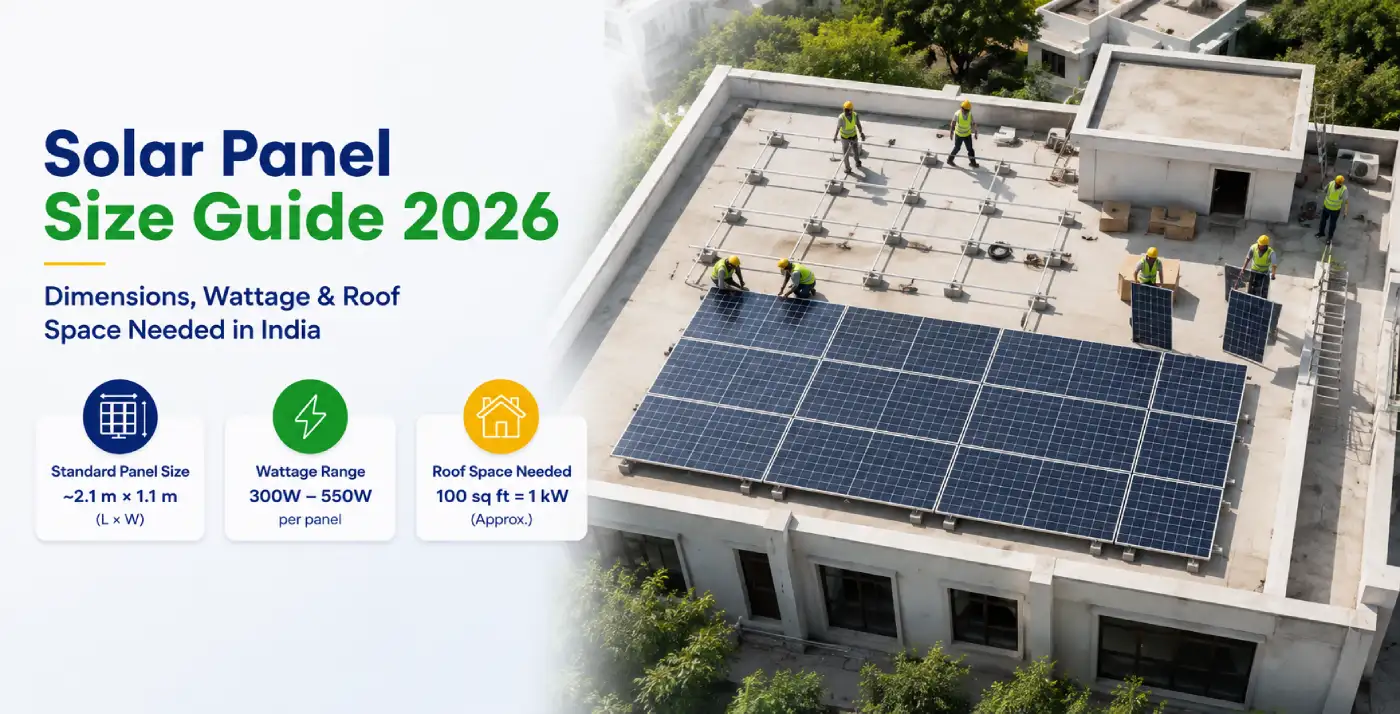
Planning a rooftop solar system usually starts with one simple worry — will the panels actually fit on your roof? Most homeowners in India don’t have unlimited terrace space, and between water tanks, staircases, and overhead wires, the usable area can shrink fast. This is exactly where understanding solar panel size becomes useful, because it tells you not just how big one panel is, but how many you’ll need and how much roof area your dream system will actually require.
In this guide, we’ll walk you through everything: standard solar panel dimensions used in India today, how panel size differs between residential and commercial setups, a roof-space chart for 1kW to 10kW systems, how newer panel technologies like Mono PERC and TOPCon affect sizing, and what it all means for your final installation cost with subsidy. By the end, you’ll be able to look at your rooftop and know exactly what size of solar system it can realistically hold.
Why Solar Panel Size Matters
Solar panel size directly decides how much electricity your roof can generate, how many panels you’ll need, and how efficiently your available space gets used.
Getting this right at the planning stage saves you from two common problems — an undersized system that doesn’t meet your electricity needs, or an oversized layout that simply won’t fit your roof.
Here’s why it matters in practice:
- Energy output: Larger, higher-wattage panels generate more electricity per unit of roof area.
- Panel count: Higher-wattage panels mean fewer panels are needed to reach the same system capacity.
- Roof space planning: Correct sizing avoids wasted space and awkward panel layouts around obstructions like water tanks or AC units.
- Installation cost: Fewer panels usually mean fewer mounting structures and less wiring, which can bring installation costs down slightly.
- Future scalability: Knowing your panel-to-space ratio makes it easier to plan for adding capacity later if your electricity usage grows.
Read also: How Much Solar Capacity Do You Need Based on Your Electricity Bill?
What is the Standard Solar Panel Size in India?
Most rooftop solar panels installed in India today measure approximately 2 to 2.1 meters in length and 1 to 1.1 meters in width, with wattage typically ranging between 500W and 600W+.
Panel sizing has changed considerably over the last few years as manufacturers moved toward higher-efficiency cell technology. Here’s a quick comparison of older versus current standard panels:
Older-generation panels (still available, lower wattage):
- Cell configuration: 60-cell or early half-cut designs
- Dimensions: ~1.6–1.7 m × ~1 m
- Wattage: 300–400W
- Weight: ~18–20 kg
Current-generation panels (widely used in 2026 installations):
- Cell configuration: 144 half-cut cells
- Dimensions: ~2–2.1 m × ~1–1.1 m
- Wattage: 500–600W+
- Weight: ~26–30 kg
Actual dimensions vary by manufacturer and cell technology, so it’s always worth checking the specific datasheet before finalising a panel brand.
Solar Panel Size Chart: Residential vs Commercial
Residential and commercial installations don’t just differ in scale — the panels used are often sized differently too, based on available roof area and energy demand.
| Feature | Residential Panels | Commercial Panels |
|---|---|---|
| Common cell configuration | 120 half-cut, 144 half-cut | 72 full-cell, 144 half-cut, bifacial |
| Typical dimensions | ~1.7 m × 1 m (mid-wattage) to ~2.1 m × 1.1 m (high-wattage) | ~2.0–2.4 m × 1.1 m |
| Typical wattage | 330–600W | 500–600W+ |
| Typical weight | 18–30 kg | 32–35 kg |
| Common system size range | 1kW – 10kW | 20kW – MW-scale |
Why this matters: if you’re comparing quotes and one installer proposes noticeably fewer panels than another for the same system size, it likely means they’re using higher-wattage modules — not cutting corners. Always check the wattage-per-panel figure, not just the panel count.
Read also: 3kW Solar System in India: Price, Subsidy & Buying Guide
How Much Roof Space Do You Need? (1kW to 10kW Calculator)
As a general rule of thumb, a rooftop solar system needs approximately 100 square feet of shadow-free roof area per 1kW of capacity.
This is a planning estimate — actual space needed can vary slightly based on panel wattage, tilt angle, and layout, but it’s a reliable starting point for most Indian homes.
| System Size | Approx. Panels Needed (540W panels) | Shadow-Free Roof Area Needed |
|---|---|---|
| 1 kW | ~2 panels | ~100 sq. ft |
| 2 kW | ~4 panels | ~200 sq. ft |
| 3 kW | ~6 panels | ~300 sq. ft |
| 5 kW | ~9–10 panels | ~500 sq. ft |
| 10 kW | ~18–19 panels | ~1,000 sq. ft |
The formula is simple: Number of panels needed = System size (in watts) ÷ Panel wattage.
For example, a 3kW (3,000W) system built with 540W panels needs roughly 6 panels (3,000 ÷ 540 ≈ 5.5, rounded up).
Tip: Instead of manually calculating this, you can use Servotech’s Solar Calculator to instantly estimate the right system size and panel count based on your monthly electricity bill.
Read also: Can Your House Run on a 5kW Solar System?
How to Measure the Right Solar Panel Size for Your Home
You don’t need any special tools to get a reasonably accurate estimate before consulting an installer. Here’s how to approach it:
Step 1: Measure Your Usable Roof Area
Walk your terrace and identify the shadow-free zones. Exclude areas blocked by water tanks, staircases, parapet walls, or overhead lines — panels installed under shade produce significantly less power.
Step 2: Check Your Monthly Electricity Consumption
Pull out your last 2-3 electricity bills and note your average monthly and yearly usage in units (kWh). This tells you how much capacity you actually need, not just how much your roof can fit.
Step 3: Apply the Space-to-Capacity Rule
Divide your available shadow-free area by 100 sq. ft. to get a rough system size your roof can support.
Step 4: Match Roof Capacity With Consumption Needs
Compare what your roof allows against what your consumption requires. The right system size is the one that satisfies both — not just whichever number is bigger.
Step 5: Choose Panel Wattage Based on the Outcome
If your roof space is limited but your consumption is high, higher-wattage panels help you fit more capacity into less area. If space isn’t a constraint, mid-wattage panels can also work well.
Note: Tilt angle, roof orientation, and local shading patterns also affect real-world output, so a professional site survey is always recommended before finalising your system.
Panel Technology and Its Effect on Size — Mono PERC vs TOPCon
Solar panel size alone doesn’t tell the full story — the cell technology inside the panel affects how much power you get from that same physical footprint.
Mono PERC Solar Panels (Passivated Emitter and Rear Cell):
- Uses monocrystalline silicon with a rear passivation layer that reflects unused light back into the cell
- Efficiency of up to approximately 22.5%
- Well-established, cost-effective, widely used across Indian rooftops
TOPCon Solar Panels (Tunnel Oxide Passivated Contact):
- Uses N-type silicon with an advanced passivation layer for better electron flow
- Efficiency of up to approximately 26%
- Performs better in high-temperature conditions and typically degrades more slowly over time
What this means for your roof: for the same physical panel size, a TOPCon module will generally output more power than a Mono PERC module — useful information if your roof space is tight and you need to maximise output per square foot.
Factors Beyond Size That Affect Panel Performance
A bigger panel doesn’t automatically mean better long-term value. Before finalising your purchase, weigh these factors alongside size:
- Efficiency: How much sunlight the panel actually converts into usable electricity
- Temperature coefficient: How much output drops as panel temperature rises during Indian summers
- Degradation rate: How much output the panel loses each year over its lifespan
- Product warranty: Typically 12–25 years, covering manufacturing defects
- Performance warranty: Usually 25 years, guaranteeing a minimum output percentage
- Certification: Look for BIS and MNRE compliance to ensure safety and eligibility for subsidy schemes
Solar Panel Size vs Cost in India (with Subsidy)
Panel size and system capacity directly influence your total investment, but the PM Surya Ghar Muft Bijli Yojana subsidy significantly reduces the net cost for residential consumers.
Under the current scheme structure:
| System Size | Central Subsidy (Approx.) |
|---|---|
| 1 kW | ₹30,000 |
| 2 kW | ₹60,000 |
| 3 kW and above | ₹78,000 (capped) |
The final installed cost — before and after subsidy — depends on several variables beyond just panel size:
- Panel brand and wattage selected
- Inverter type and capacity
- Mounting structure and roof type
- Net metering charges from your DISCOM
- Installer’s service quality and after-sales support
Because pricing varies by city, DISCOM, and installer, it’s best to get a personalised quote rather than relying on a generic number. You can use Servotech’s Solar Calculator to get an estimate tailored to your consumption and location.
Read also: How Much Electricity Can a Single Solar Panel Produce?
Why Choose Servotech for Your Rooftop Solar System
Getting the panel size and system capacity right is only half the job — the quality of installation determines how well your system performs over the next 25 years.
Servotech Renewable Power System Ltd. offers complete rooftop solar solutions designed around your actual roof space and electricity needs, including:
- Free site assessment and shadow analysis
- Custom system design matched to your roof dimensions
- High-efficiency solar panels and advanced inverters
- BIS/MNRE-compliant, ALMM-listed equipment
- End-to-end subsidy documentation support
- Net metering coordination with your DISCOM
- Reliable after-sales service across India
Whether you’re working with a compact terrace or a large rooftop, Servotech helps you make the most of every available square foot.
Frequently Asked Questions (FAQs)
Most current rooftop panels measure approximately 2 to 2.1 meters in length and 1 to 1.1 meters in width, with wattage typically between 500W and 600W+.
It depends on wattage. A 330–400W panel is typically around 1.6–1.7 m × 1 m, while a 500–600W panel is closer to 2–2.1 m × 1–1.1 m.
Modern high-wattage residential panels weigh approximately 26–30 kg, while larger commercial solar panels can weigh 32–35 kg.
Roughly 9–10 panels if using 540W-class modules, though this can vary slightly with different panel wattages.
Roughly 9–10 panels if using 540W-class modules, though this can vary slightly with different panel wattages.
Not necessarily size alone — cell technology and efficiency matter just as much. A smaller, high-efficiency TOPCon panel can outperform a larger, lower-efficiency panel.
generally optimised for limited rooftop space (1kW–10kW systems), while commercial panels are larger-format modules designed for bigger installations (20kW and above).
Yes. Smaller roofs can still support a meaningful system size, especially with higher-wattage panels that reduce the number of modules needed.
Yes. If your roof has partial shading issues, your installer may recommend specific panel placement or technology choices to minimise the impact on output.
Quality panels generally come with a 25-year performance warranty and continue operating at a high percentage of their original output through that period.
Indirectly. Fewer, higher-wattage panels can reduce mounting and wiring costs slightly, but overall pricing depends more on total system capacity and component quality.
You can use Servotech’s Solar Calculator to get a quick, consumption-based estimate of the right system size for your roof.
Conclusion
Solar panel size might seem like a small technical detail, but it’s actually one of the first things that determines whether your rooftop solar plan is realistic. Knowing the standard dimensions, understanding how roof space translates into system capacity, and factoring in newer technologies like TOPCon can help you make a far more informed decision than simply picking whichever quote looks cheapest.
The right approach is always to balance three things — your available roof space, your actual electricity consumption, and the panel technology that makes the most of both. Once these align, you’re not just installing solar panels — you’re setting up a system that will genuinely work for your home for the next 25 years.