Delhi Government to Install 540 EV Chargers Across 180 Locations in the Capital
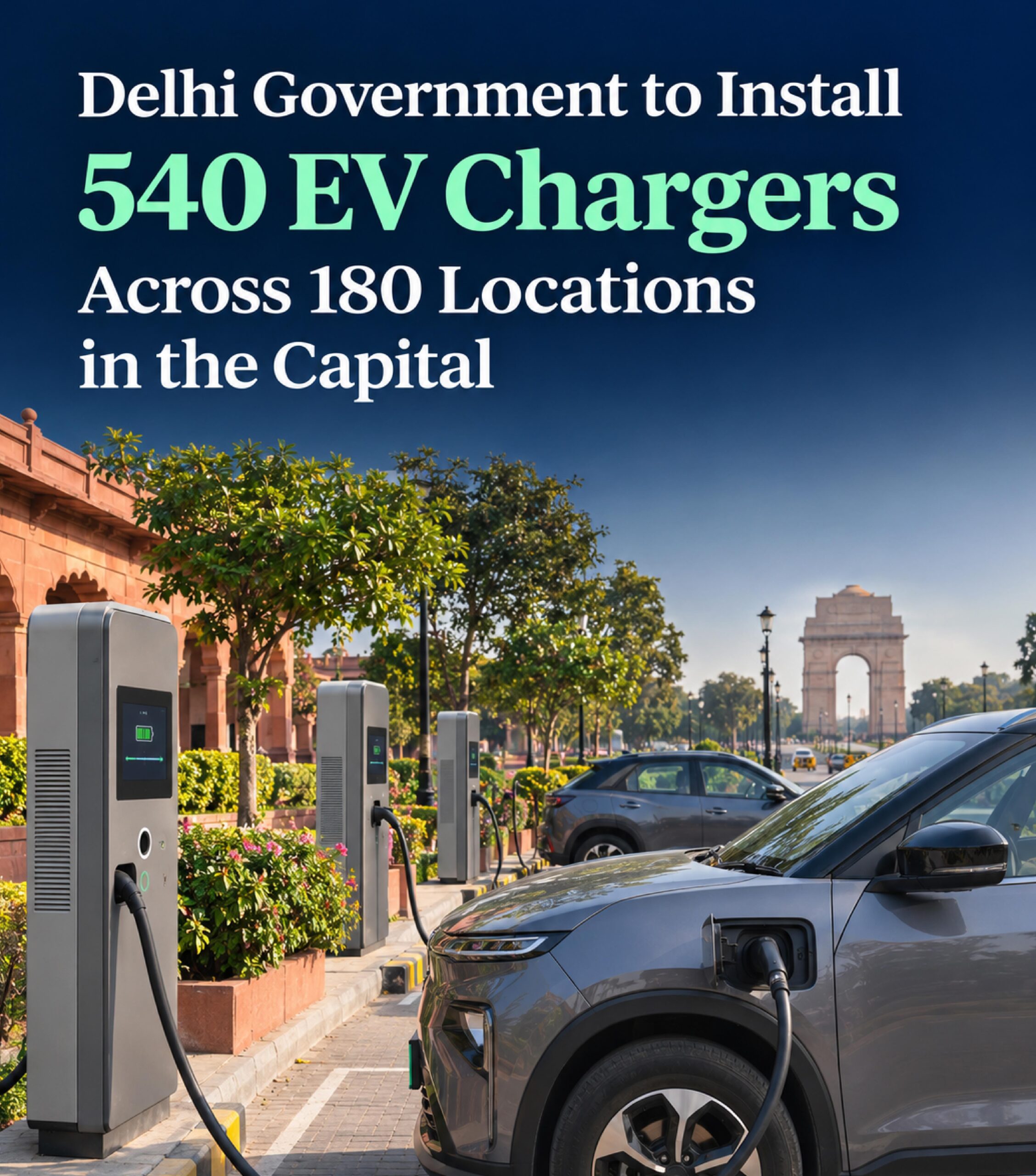
To boost its mission of accelerating EV adoption in the capital, the Delhi Government is all set to expand its public EV Charging infrastructure with 540 EV Chargers across 180 locations in the state.
Delhi government’s nodal agency, Transco, has started the process to appoint operators to set up and operationalise the chargers under the PM E-drive scheme. With an estimated cost of approximately ₹62 crore, the project will be developed with the charger configuration approved by the Ministry of Heavy Industries.
What Type of Chargers will be Installed under the Project?
Under the project, each of the 180 locations will have 3 types of EV Chargers with two charging guns each.
| Charger Capacity | Number of Charging Guns | Targetted Vehicles |
| 12 kW | 2 | Electric 2 & 3 Wheelers |
| 60 kW | 2 | N1 goods carriers (3.5-ton commercial vehicles), electric 4-wheelers and private cars |
| 120 kW | 2 | Heavy vehicles and other compatible vehicles |
Together, these add up to 3 chargers per site. For 180 sites across the capital, a total of 540 EV chargers will be installed.
Targeted Locations for EV Charger Installation
The 180 sites are grouped into 90 Sites each, in two packages, broadly based on geographical distribution for even EV Charging access to EV owners across the capital.
- Package 1: Primarily covers Western and Northern Delhi.
- Package 2: Primarily covers Southern Delhi, New Delhi and Eastern Delhi.
The shortlisted Central Delhi sites occur in two distinct geographic clusters:
- Six locations around Inderlok, Pratap Nagar, Shahi Idgah and Kamla Market / LNJP Hospital.
- Two co-located sites at Rajghat.
What this Means for Delhi’s 2029 EV Charging Infrastructure Target?
The Commission for Air Quality Management (CAQM) has prescribed a target of 32,062 EV charging points in Delhi by December 2029, to be achieved in phases. The 540 chargers under this project are part of the broader effort to expand public charging infrastructure. Under the Delhi EV Policy 2026, Delhi Transco Limited (DTL) has been appointed as the nodal agency responsible for overseeing the planning, coordination and implementation of public EV charging and battery swapping infrastructure across Delhi.
Why is Delhi expanding its charging network?
The EV Charging point expansion project has come across at a critical point to accelerate EV adoption and improve air quality. Since road transport is a significant contributor to Delhi’s air pollution, helping people adopt electric vehicles in the capital is considered important in reducing transport-related pollution.
For this, Delhi government has come up with some great schemes and benefits such as Purchase incentives, scrapping incentives, road tax and registration fee exemptions, phased electrification mandates, and expansion of EV charging and battery swapping infrastructure.
The Big Picture behind Delhi’s EV Acceleration
Delhi’s planned expansion of public EV charging infrastructure marks another step towards supporting the capital’s growing electric mobility ecosystem. This initiative to add new EV Chargers is a great step in that direction, aiming to improve charging accessibility, accommodate rising EV demand, and complement the city’s electrification policies. As Delhi advances towards its 2029 charging infrastructure target, the development of a reliable, accessible, and scalable charging network will remain crucial to accelerating EV adoption and supporting cleaner urban mobility.
Sources: PTI, WorldAutoForum